Carrboro Commercial Historic District

Why it's listed
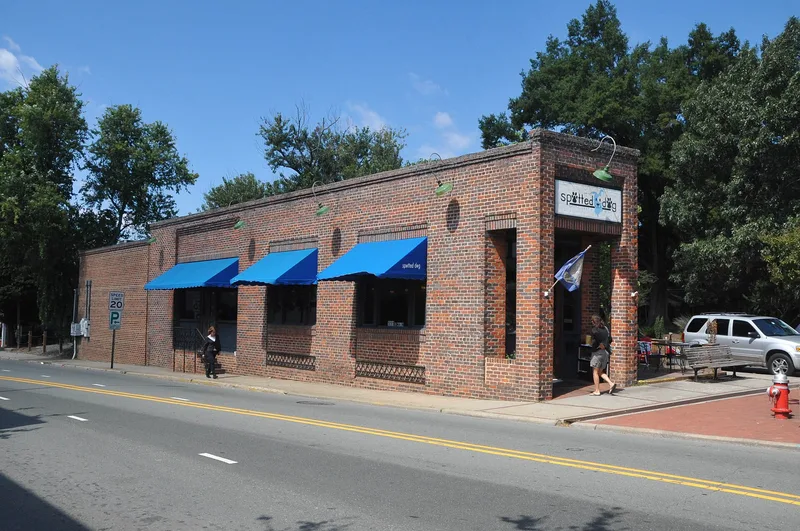
Sixteen commercial buildings line the 100 block of East Main Street in Carrboro, North Carolina, forming the town's oldest surviving business district. The stores grew up to serve textile workers at the Alberta Cotton Mill, founded in 1899, and most were built between about 1910 and 1924. A fire in 1924 destroyed the frame buildings at the north end of the block. Owners rebuilt in brick, which became the preferred material. The result is a row of modestly detailed one- and two-story buildings with corbelled brick panels, molded metal cornices, large display windows and transoms. Notable examples include Hearn's Grocery, the triangular Flatiron Building, the two-story trio at 118-120 East Main Street that housed a drug store and a silent movie theater, and the frame Miles Andrews House, the only building to survive from the block's mixed residential and commercial past. Alterations have generally been minor, and the block visually complements the neighboring Alberta Mill Complex.
Significance in brief: The block is the oldest surviving part of Carrboro's early commercial district, which grew up to serve workers at the Alberta Cotton Mill and other local textile mills. Its modest one- and two-story brick buildings are good, largely unaltered examples of early twentieth-century commercial architecture. The block also complements the adjacent Alberta Mill Complex.
Machine-generated summary. This summary was generated by a language model from the official nomination document and has not been reviewed line by line by an editor. It may contain errors. Check the source document before relying on any detail. Source: nomination document (PDF) · National Archives catalog entry. NRHP reference 85001339, listed June 20, 1985. Summary generated October 2026 (model claude-sonnet-5-5, prompt v1.0-2026-10-29, confidence high).
Key facts
| Address | 100 Blk. of E. Main St. between Greensboro Rd. & Roberson St., Carrboro |
|---|---|
| County | Orange County |
| Listed | June 20, 1985 |
| Reference number | 85001339 |
| Resource type | District |
| Period of significance | C. 1910 - 1924 |
| Architect / builder | various and unknown |
| Criteria |
|
| Areas of significance | Commerce, Architecture |
| Level of significance | Local |
| Status (as stated in the nomination) | Condition is listed as excellent to good and altered. Twelve buildings are pivotal or contributing and four are non-contributing. The buildings are occupied and in commercial use. |
| Acreage | 2.8 |
| Coordinates | 35.91038, -79.07148 (NPS GIS) |
What listing means for this property
This is a historic district. Buildings within its boundary are either contributing (they add to the district's significance) or non-contributing. Owners of contributing income-producing buildings can claim the 20% federal rehabilitation tax credit; homeowners should look at state credits. National Register districts impose no design review by themselves; a local historic district ordinance, if one exists, does (the difference explained).
General information, not legal or tax advice. Rules change; confirm with your State Historic Preservation Office or a qualified adviser.
Sources and further reading
- National Park Service, National Register of Historic Places database (snapshot May 2026), reference 85001339.
- Nomination form (PDF, National Archives) — catalog entry
- Wikipedia article (used for cross-checking only; text not reproduced here)
- Wikidata Q19600671
- This listing as JSON
Last updated October 2026. Found an error? See the editorial policy for how to report it.