Alberta Mill Complex

Why it's listed
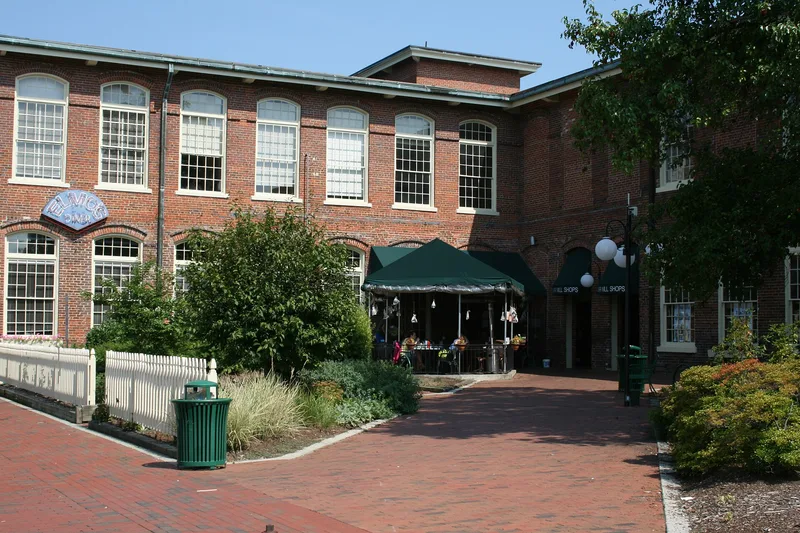
Carrboro's Alberta Mill Complex brings together three industrial structures at the center of the town: a brick cotton mill, a railroad depot and a brick grist mill, set around a tree-shaded green with six-sided brick well houses. The mill, built in 1898-99 for Thomas F. Lloyd, has a two-story main block, square towers, segmental-arched windows and a plain mid-twentieth-century warehouse addition. The depot, extended in 1913, keeps separate waiting rooms for white and black passengers. The complex matters because the railroad spur serving the reopened University of North Carolina ended here, and mills, a cotton gin and a large cross-tie market grew up around the station. Lloyd's mill was sold in 1909 to Julian S. Carr's Durham Hosiery Company, and the town took the Carr name in 1913. Decline began in the 1930s, and rail traffic ended in 1938. The mill, depot and brick warehouse are the remaining reminders of that industrial past.
Significance in brief: From 1882 to 1938 the complex served as a center of transportation, commerce and industry for Orange and neighboring counties. It was tied to the reopening of the University of North Carolina at Chapel Hill, which depended on the spur-line station. It was also the reason the town of Carrboro came to exist, and it is linked to Thomas Lloyd and Julian Carr.
Machine-generated summary. This summary was generated by a language model from the official nomination document and has not been reviewed line by line by an editor. It may contain errors. Check the source document before relying on any detail. Source: nomination document (PDF) · National Archives catalog entry. NRHP reference 76001332, listed January 19, 1976. Summary generated October 2026 (model claude-sonnet-5-5, prompt v1.0-2026-10-29, confidence medium).
Key facts
| Address | NE corner Weaver and N. Greensboro Sts., Carrboro |
|---|---|
| County | Orange County |
| Listed | January 19, 1976 |
| Reference number | 76001332 |
| Resource type | Building |
| Period of significance | 1800-1899 (specific dates 1898; 1913) |
| Areas of significance | Industry, Commerce |
| Level of significance | Local |
| Status (as stated in the nomination) | Listed as occupied and unoccupied in part; condition fair and altered. The mill's windows are largely bricked up, its tower roofs were removed, and the mid-twentieth-century warehouse addition is still in use. |
| Acreage | 10 |
| Coordinates | 35.91147, -79.07101 (NPS GIS) |
What listing means for this property
For an income-producing building, listing (individually or as a contributing building in a district) is the gateway to the 20% federal rehabilitation tax credit on qualified rehabilitation costs, often stackable with state credits. Work claiming the credit must follow the Secretary of the Interior's Standards and be approved in advance.
Listing does not restrict a private owner acting without federal money or permits; where federal funding or licensing is involved, Section 106 review applies.
General information, not legal or tax advice. Rules change; confirm with your State Historic Preservation Office or a qualified adviser.
Sources and further reading
- National Park Service, National Register of Historic Places database (snapshot May 2026), reference 76001332.
- Nomination form (PDF, National Archives) — catalog entry
- Wikipedia article (used for cross-checking only; text not reproduced here)
- Wikidata Q5045977
- This listing as JSON
Last updated October 2026. Found an error? See the editorial policy for how to report it.