Mecklenburg Investment Company Building

Why it's listed
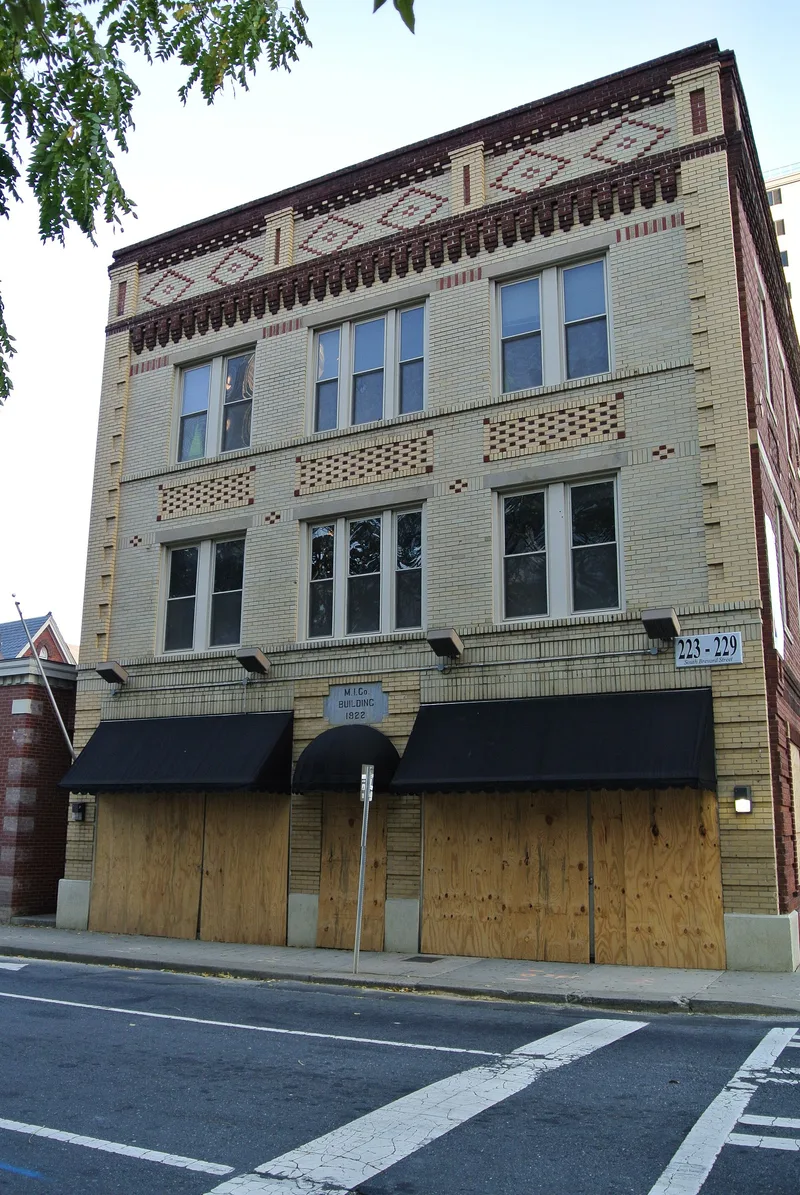
Completed in late 1922 at South Brevard and East Third streets in Charlotte, this three-story brick building was financed by the Mecklenburg Investment Company, a firm formed in 1921 by leading black citizens who sold shares to raise money for rental offices. Black builder William W. Smith constructed it, apparently without an architect. The front elevation uses buff brick with red trim, patterned panels and a bracketed cornice, while the side facade is red brick. Inside, stores occupied the ground floor, offices the second, and a Masonic lodge meeting room with a coffered ceiling the third. For about forty years it housed black dentists, lawyers, doctors and businesses, and hosted lodge meetings and dances. It is significant as an expression of the 1920s black middle class and the "New Negro" movement, and as an example of Smith's work. Urban renewal later erased most of the Brooklyn neighborhood, leaving this building and Grace A.M.E. Zion Church among the few survivors.
Significance in brief: The building is tied to the 1920s "New Negro" movement and the rise of a black urban middle class, built with shareholder money from Charlotte's black professionals and businessmen. It is linked to community leaders such as Caesar Robert Blake, Thad L. Tate and Dr. J. T. Williams. It is also significant as the work of black builder William W. Smith, and it is one of the few survivors of the demolished Brooklyn neighborhood.
Machine-generated summary. This summary was generated by a language model from the official nomination document and has not been reviewed line by line by an editor. It may contain errors. Check the source document before relying on any detail. Source: nomination document (PDF) · National Archives catalog entry. NRHP reference 82003486, listed August 19, 1982. Summary generated October 2026 (model claude-sonnet-5-5, prompt v1.0-2026-10-29, confidence high).
Key facts
| Address | 233 S. Brevard St., Charlotte |
|---|---|
| County | Mecklenburg County |
| Listed | August 19, 1982 |
| Reference number | 82003486 |
| Resource type | Building |
| Period of significance | 1922 |
| Architect / builder | William W. Smith |
| Architectural style | Symmetrical, somewhat classical commercial design with ornamental and patterned brickwork |
| Criteria |
|
| Areas of significance | Black, Architecture, Social History |
| Level of significance | State |
| Status (as stated in the nomination) | Described as deteriorated and unoccupied at the time of nomination; the commercial spaces and old doctor's suite and Masonic lodge room survive inside. |
| Acreage | 0.9 |
| Coordinates | 35.22299, -80.84189 (NPS GIS) |
What listing means for this property
For an income-producing building, listing (individually or as a contributing building in a district) is the gateway to the 20% federal rehabilitation tax credit on qualified rehabilitation costs, often stackable with state credits. Work claiming the credit must follow the Secretary of the Interior's Standards and be approved in advance.
Listing does not restrict a private owner acting without federal money or permits; where federal funding or licensing is involved, Section 106 review applies.
Noted as vacant in the nomination. Nomination documents can be decades old; current status may differ. If you are considering buying an empty listed property, read the due-diligence checklist.
General information, not legal or tax advice. Rules change; confirm with your State Historic Preservation Office or a qualified adviser.
Sources and further reading
- National Park Service, National Register of Historic Places database (snapshot May 2026), reference 82003486.
- Nomination form (PDF, National Archives) — catalog entry
- Wikipedia article (used for cross-checking only; text not reproduced here)
- Wikidata Q19987073
- This listing as JSON
Last updated October 2026. Found an error? See the editorial policy for how to report it.