Grace A.M.E. Zion Church

Why it's listed
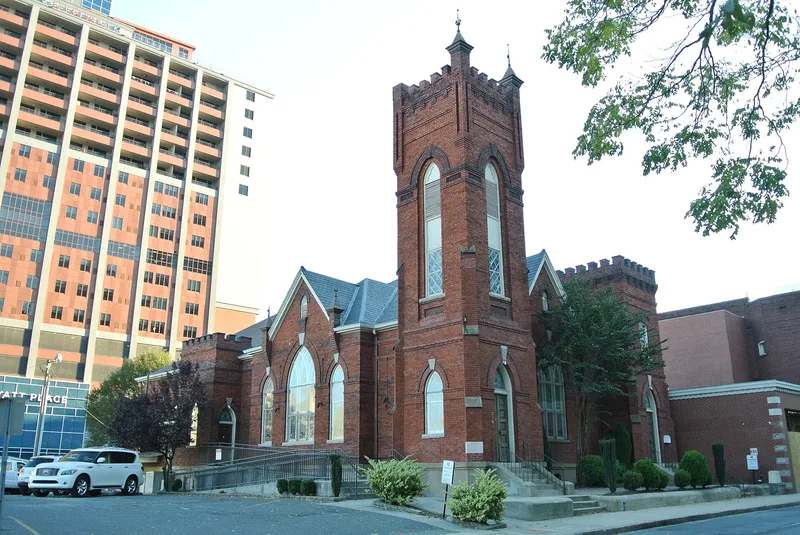
Grace A.M.E. Zion Church is a red brick Gothic Revival church on South Brevard Street in downtown Charlotte. Designed by the firm Hayden, Wheeler and Schwend and built by African American contractor William W. Smith, it was begun in 1901 and dedicated in 1902. Two crenellated, buttressed towers of unequal height flank the entrance, and the slate-roofed main block has stained glass windows and granite trim. Inside, the sanctuary keeps its original oak pews and an intricate coffered wood ceiling. The congregation formed in 1886 and became the church of many of the city's Black leaders, professionals and business owners. It stood in Brooklyn, Charlotte's main Black residential and commercial district, which was razed during urban renewal in the 1950s and 1960s. The church and the nearby Mecklenburg Investment Company Building are the main survivors of that neighborhood. The congregation left in 2007, and the building was sold to a preservation body for adaptive reuse.
Significance in brief: The church is one of the few surviving remnants of Brooklyn, Charlotte's principal African American neighborhood, which was demolished in urban renewal in the 1950s and 1960s. It was a central gathering place for the city's Black elite and community leaders. It is also considered among the finest turn-of-the-century Gothic Revival churches in Charlotte.
Machine-generated summary. This summary was generated by a language model from the official nomination document and has not been reviewed line by line by an editor. It may contain errors. Check the source document before relying on any detail. Source: nomination document (PDF) · National Archives catalog entry. NRHP reference 08000412, listed May 15, 2008. Summary generated October 2026 (model claude-sonnet-5-5, prompt v1.0-2026-10-29, confidence high).
Key facts
| Address | 219-223 S. Brevard St., Charlotte |
|---|---|
| County | Mecklenburg County |
| Listed | May 15, 2008 |
| Reference number | 08000412 |
| Resource type | Building |
| Period of significance | 1902-1957 |
| Architect / builder | Hayden, Wheeler and Schwend (architects); Smith, William W. (builder/contractor) |
| Architectural style | Gothic Revival |
| Criteria |
|
| Areas of significance | Black, Architecture, Social History |
| Level of significance | Local |
| Status (as stated in the nomination) | The congregation moved to a new building in 2007 and sold the church to the Charlotte-Mecklenburg Historic Landmarks Commission, which plans preservation covenants and sale for adaptive reuse. The form lists current function as vacant/not in use. |
| Acreage | 0.3 |
| Coordinates | 35.22326, -80.84178 (NPS GIS) |
What listing means for this property
Religious properties are listed for their architectural or historical significance, not their religious use. Listing is honorary and does not restrict the congregation's use of the building. The federal rehabilitation credit is generally unavailable unless part of the building is income-producing; some state programmes and preservation grants do cover religious buildings. Federal funding or permits trigger Section 106 review.
Noted as vacant in the nomination. Nomination documents can be decades old; current status may differ. If you are considering buying an empty listed property, read the due-diligence checklist.
General information, not legal or tax advice. Rules change; confirm with your State Historic Preservation Office or a qualified adviser.
Sources and further reading
- National Park Service, National Register of Historic Places database (snapshot May 2026), reference 08000412.
- Nomination form (PDF, National Archives) — catalog entry
- Wikipedia article (used for cross-checking only; text not reproduced here)
- Wikidata Q5590955
- This listing as JSON
Last updated October 2026. Found an error? See the editorial policy for how to report it.