Mock, Judson, Voehringer Company Hosiery Mill
Also known as: Mojud Hosiery Company; Rolane Factory Outlet Store

Why it's listed
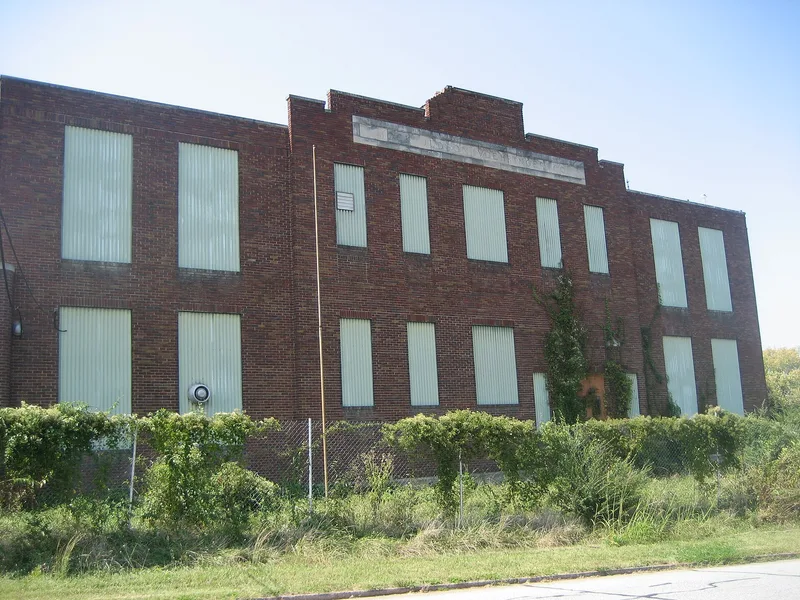
Built from 1927 as a hosiery mill at 2610 Oakland Avenue in southwest Greensboro, the complex grew through additions in 1928, 1930, 1936 and 1938 into a long reinforced concrete block of roughly 120,000 to 140,000 square feet, clad in brick. Its operator, the Mock, Judson, Voehringer Company, later renamed Mojud Hosiery Company, produced silk and then nylon hosiery and employed hundreds of workers, reaching more than 2,000 in the 1950s. The mill is recognized for its role in the city's textile industry and for hosiery methods introduced there, including picot top and heel attachments and full-fashioned knitting. Its interior remains largely open and unaltered, and its window openings were infilled with brick in the 1940s to control temperature for the knitting machines. A 1938 Art Moderne retail store, a 1927 boiler house and a brick chimney are part of the complex. The property was listed for its industrial history and the surviving form of the plant.
Significance in brief: The nomination argues the mill is significant under Criterion A for industry because of its role in Greensboro's textile industry, as one of the city's largest employers in the period. It notes the plant's hosiery innovations, its labor history, and the mill's largely intact interior and exterior form.
Machine-generated summary. This summary was generated by a language model from the official nomination document and has not been reviewed line by line by an editor. It may contain errors. Check the source document before relying on any detail. Source: nomination document (PDF) · National Archives catalog entry. NRHP reference 11000141, listed March 28, 2011. Summary generated October 2026 (model claude-haiku-5-5, prompt v1.1-2026-10-29, confidence medium).
Key facts
| Address | 2610 Oakland Ave, Greensboro |
|---|---|
| County | Guilford County |
| Listed | March 28, 2011 |
| Reference number | 11000141 |
| Resource type | Building |
| Period of significance | 1927- ca. 1956 |
| Architectural style | Modern Movement: Moderne |
| Criteria |
|
| Areas of significance | Industry |
| Level of significance | Local |
| Status (as stated in the nomination) | Closed after Kayser-Roth operated it until 1972; mostly empty afterward, with a factory outlet store closing in 1999; the document states the mill has been vacant for the past decade. |
| Acreage | 8.8 |
| Coordinates | 36.06221, -79.83543 (NPS GIS) |
What listing means for this property
For an income-producing building, listing (individually or as a contributing building in a district) is the gateway to the 20% federal rehabilitation tax credit on qualified rehabilitation costs, often stackable with state credits. Work claiming the credit must follow the Secretary of the Interior's Standards and be approved in advance.
Listing does not restrict a private owner acting without federal money or permits; where federal funding or licensing is involved, Section 106 review applies.
Noted as vacant in the nomination. Nomination documents can be decades old; current status may differ. If you are considering buying an empty listed property, read the due-diligence checklist.
General information, not legal or tax advice. Rules change; confirm with your State Historic Preservation Office or a qualified adviser.
Sources and further reading
- National Park Service, National Register of Historic Places database (snapshot May 2026), reference 11000141.
- Nomination form (PDF, National Archives) — catalog entry
- Wikipedia article (used for cross-checking only; text not reproduced here)
- Wikidata Q18154532
- This listing as JSON
Last updated October 2026. Found an error? See the editorial policy for how to report it.