Bumpas-Troy House

Why it's listed
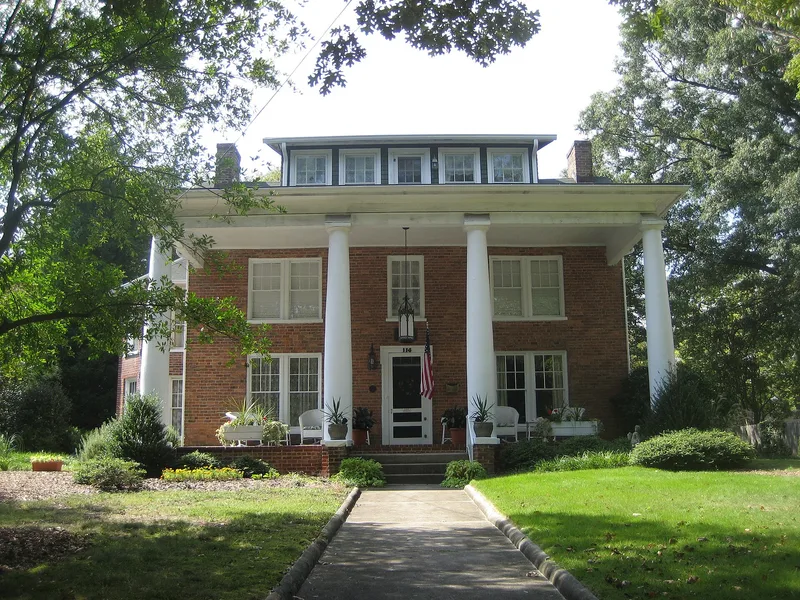
Built in 1847 on land bought from Greensboro College, this brick house on South Mendenhall Street was the home of Methodist minister Sidney D. Bumpas and his family. It is a three-bay, two-and-one-half-story Greek Revival building with a four-columned portico, Flemish bond variation brickwork and a Greek Revival front door. A 1911 remodeling added a southwest wing with a projecting bay, a third-floor apartment and a long shed dormer, and changed much of the interior, though the original character survives. Two frame outbuildings, a smokehouse and a carriage house, remain behind it. The house is noted as one of the few Greek Revival buildings left in Greensboro. It is also closely linked to Frances Bumpas, who after her husband's death in 1851 ran The Weekly Message, an early Methodist-related newspaper, from the house until 1872. She later helped establish women's missionary societies in the church. The house stayed in the family until 1975.
Significance in brief: The nomination calls it one of the few surviving Greek Revival buildings in Greensboro. It is also tied to Frances Moore Webb Bumpas, who edited and published the Methodist-related weekly The Weekly Message from 1851 to 1872 and later helped organize women's missionary work. The house stayed in the Bumpas family until 1975.
Machine-generated summary. This summary was generated by a language model from the official nomination document and has not been reviewed line by line by an editor. It may contain errors. Check the source document before relying on any detail. Source: nomination document (PDF) · National Archives catalog entry. NRHP reference 77001000, listed December 6, 1977. Summary generated October 2026 (model claude-sonnet-5-5, prompt v1.0-2026-10-29, confidence high).
Key facts
| Address | 114 S. Mendenhall St., Greensboro |
|---|---|
| County | Guilford County |
| Listed | December 6, 1977 |
| Reference number | 77001000 |
| Resource type | Building |
| Period of significance | 1800-1899 |
| Architectural style | Greek Revival |
| Areas of significance | Education, Religion |
| Level of significance | Local |
| Status (as stated in the nomination) | Form lists the property as occupied and in good condition. The house has been altered, notably in 1911, but its integrity is described as intact. |
| Acreage | 0.9 |
| Within district | College Hill Historic District |
| Coordinates | 36.07235, -79.80308 (NPS GIS) |
What listing means for this property
National Register listing is honorary for a privately owned home: it does not by itself restrict what an owner may do with their own money, and it does not require public access. Restrictions come from local landmark or historic-district ordinances, which are separate (how they differ).
Owner-occupied houses are not eligible for the 20% federal rehabilitation tax credit, which applies to income-producing buildings, but many states offer credits for homeowners. Listing also opens the door to preservation easements and to buying a plaque. Start with what listing means for homeowners, renovating a listed house and selling one.
General information, not legal or tax advice. Rules change; confirm with your State Historic Preservation Office or a qualified adviser.
Sources and further reading
- National Park Service, National Register of Historic Places database (snapshot May 2026), reference 77001000.
- Nomination form (PDF, National Archives) — catalog entry
- Wikipedia article (used for cross-checking only; text not reproduced here)
- Wikidata Q19460736
- This listing as JSON
Last updated October 2026. Found an error? See the editorial policy for how to report it.