East White Oak School, Former
Also known as: East White Oak Community Center

Why it's listed
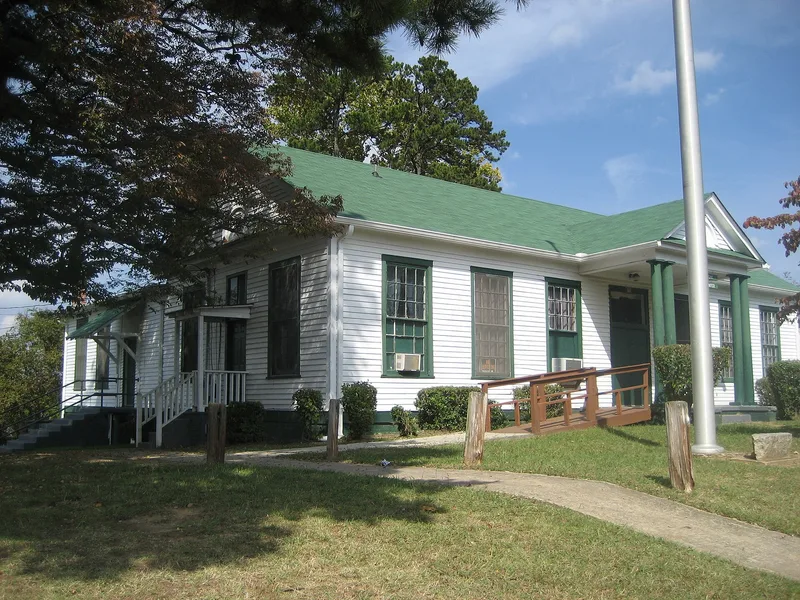
Built in 1916, this modest one-story frame school at 1801 Tenth Street in Greensboro served East White Oak, the only village the Proximity Manufacturing Company built for its black employees. Its seven-bay front has twelve-over-twelve windows and a portico with four solid wood columns and a pediment. The building was originally T-shaped, and additions of the late 1920s or 1930s made it square. The school opened with eighty-seven students and two teachers, and enrollment reached 123 by 1925. Its pupils came from families doing unskilled mill work. The company ran the school until the city system absorbed the mill village schools in 1946, after which the building became a black YMCA. When the village was sold in 1955 and its houses were later demolished, residents bought the school and turned it into a community center in 1956. It is the last original structure of the village and the only small early twentieth-century school building surviving in Greensboro.
Significance in brief: It was the only school in northeast Greensboro's only black mill village and educated the children of the company's black workers for about three decades. It is the last surviving original structure of East White Oak village and the only small early twentieth-century frame school left in the city. It is significant under Criterion A for education and black ethnic heritage.
Machine-generated summary. This summary was generated by a language model from the official nomination document and has not been reviewed line by line by an editor. It may contain errors. Check the source document before relying on any detail. Source: nomination document (PDF) · National Archives catalog entry. NRHP reference 92000360, listed April 21, 1992. Summary generated October 2026 (model claude-sonnet-5-5, prompt v1.0-2026-10-29, confidence high).
Key facts
| Address | 1801 Tenth St., Greensboro |
|---|---|
| County | Guilford County |
| Listed | April 21, 1992 |
| Reference number | 92000360 |
| Resource type | Building |
| Period of significance | 1916-1941 |
| Architect / builder | Unknown |
| Architectural style | Colonial Revival |
| Criteria |
|
| Areas of significance | Black, Education |
| Level of significance | Local |
| Status (as stated in the nomination) | Used as a community center since 1956; the interior has been altered and compromised, though the exterior looks much as it did in a 1925 photograph. |
| Acreage | 0.5 |
| Coordinates | 36.10112, -79.76010 (NPS GIS) |
What listing means for this property
For a publicly owned building or structure, listing mainly matters when federal funds, permits or licences are involved: projects then go through Section 106 review so effects on the property are considered. Listing also strengthens applications for preservation grants and, for leased income-producing uses, can enable the federal rehabilitation tax credit.
General information, not legal or tax advice. Rules change; confirm with your State Historic Preservation Office or a qualified adviser.
Sources and further reading
- National Park Service, National Register of Historic Places database (snapshot May 2026), reference 92000360.
- Nomination form (PDF, National Archives) — catalog entry
- Wikipedia article (used for cross-checking only; text not reproduced here)
- Wikidata Q18705885
- This listing as JSON
Last updated October 2026. Found an error? See the editorial policy for how to report it.