White Oak New Town Historic District

Why it's listed
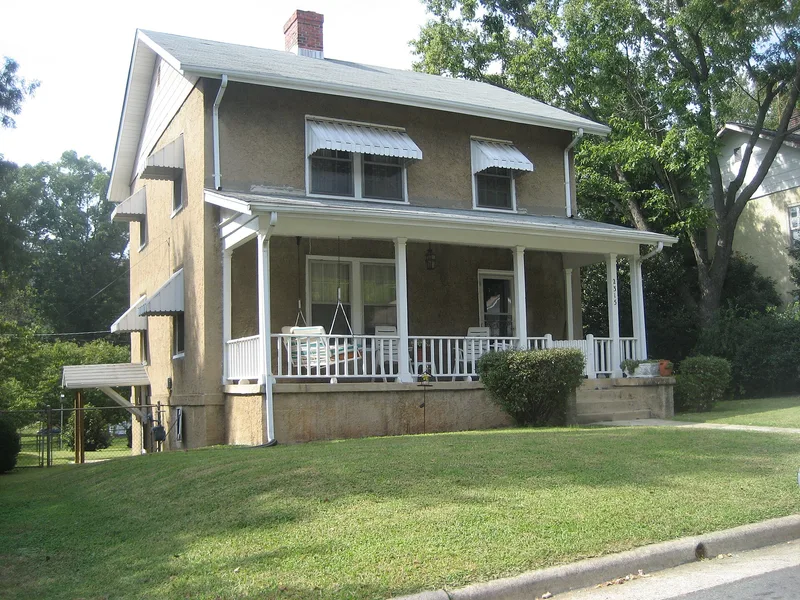
Built about 1920 by the Proximity Manufacturing Company, a Cone family firm, this mill village in northeast Greensboro contains one hundred hollow-tile houses finished in stucco and sixty-four car sheds set along parallel alleys. Eighty one-story gable-front bungalows and twenty two-story gable-end houses stand on a regular grid of streets near the White Oak Mill, about half a mile away. Each house had about four or six rooms and was rented cheaply, at roughly $1.00 to $1.25 a week in the 1920s. Residents worked in the mill as speeder operators, dolphers, card holders, weavers and loom fixers. The village is regarded as the most intact example of such housing in the city, and it documents the everyday lives of textile workers and the company's paternalistic provision of schools, gardens and housing during the 1920s and 1930s.
Significance in brief: The district is argued to be the most intact of the many mill villages in northeast Greensboro, with its houses, car sheds and lots still in their original relationships. It is presented as reflecting daily life of textile workers in the 1920s and 1930s and the role of the textile industry in shaping Greensboro's landscape. Its bungalow-form houses are described as better than contemporary mill housing.
Machine-generated summary. This summary was generated by a language model from the official nomination document and has not been reviewed line by line by an editor. It may contain errors. Check the source document before relying on any detail. Source: nomination document (PDF) · National Archives catalog entry. NRHP reference 92000176, listed April 3, 1992. Summary generated October 2026 (model claude-haiku-5-5, prompt v1.1-2026-10-29, confidence high).
Key facts
| Address | 2400--2418 N. Church, 2312--2509 Spruce, 2310--2503 Hubbard and 2401--2503 Cypress Sts., Greensboro |
|---|---|
| County | Guilford County |
| Listed | April 3, 1992 |
| Reference number | 92000176 |
| Resource type | District |
| Period of significance | 1920-1941 |
| Architect / builder | Proximity Manufacturing Company (builder) |
| Architectural style | Bungalow/Craftsman |
| Criteria |
|
| Areas of significance | Industry, Community Planning and Development, Architecture |
| Level of significance | Local |
| Status (as stated in the nomination) | All of the one hundred houses and sixty-four car sheds are described as surviving; three frame classroom buildings are no longer extant. |
| Acreage | 27 |
| Coordinates | 36.10677, -79.77875 (NPS GIS) |
What listing means for this property
This is a historic district. Buildings within its boundary are either contributing (they add to the district's significance) or non-contributing. Owners of contributing income-producing buildings can claim the 20% federal rehabilitation tax credit; homeowners should look at state credits. National Register districts impose no design review by themselves; a local historic district ordinance, if one exists, does (the difference explained).
General information, not legal or tax advice. Rules change; confirm with your State Historic Preservation Office or a qualified adviser.
Sources and further reading
- National Park Service, National Register of Historic Places database (snapshot May 2026), reference 92000176.
- Nomination form (PDF, National Archives) — catalog entry
- Wikipedia article (used for cross-checking only; text not reproduced here)
- Wikidata Q21016339
- This listing as JSON
Last updated October 2026. Found an error? See the editorial policy for how to report it.