Rondout-West Strand Historic District

Why it's listed
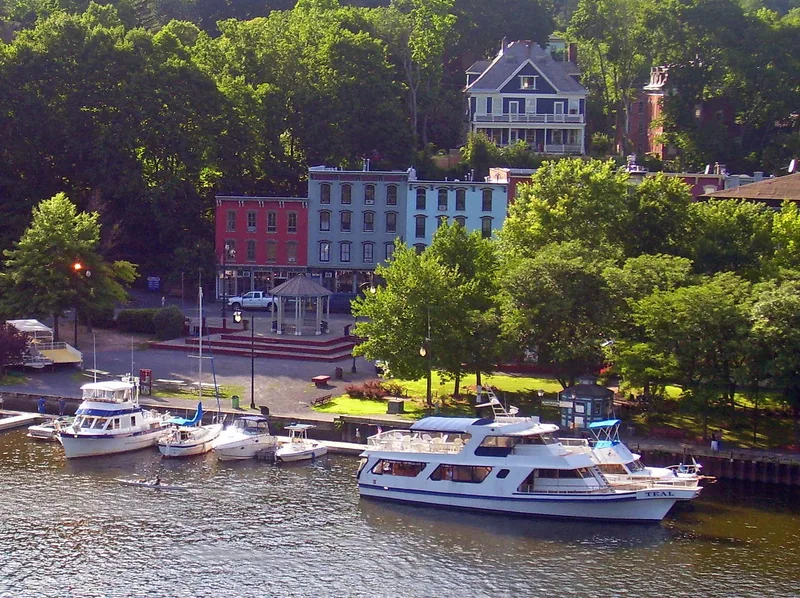
Rondout-West Strand Historic District covers 278 buildings on roughly 57 acres of steep hills above Rondout Creek in Kingston, New York. It makes up most of what survives of the nineteenth-century village of Rondout, which began as Kingston's landing, called the Strand. Commercial buildings cluster along lower Broadway and the West Strand, many with original storefronts and cast-iron columns, sills and lintels from local foundries. Residential streets are mostly two-story, three-bay houses in brick and frame, with some double houses and row houses. Styles range from Federal and Greek Revival to Italianate, Second Empire, Romanesque and Queen Anne. The village prospered through canal shipping, bluestone, cement, shipbuilding, brickmaking and ice-cutting, and declined after the Delaware and Hudson Canal closed in 1899. Notable survivors include the Freeman Building at 3 Broadway, two firehouses built around 1860, and Romanesque churches built for the German community. Twentieth-century intrusions are minimal, and demolition from 1960s urban renewal lies mostly outside the boundary.
Significance in brief: The district preserves most of the nineteenth-century village of Rondout, which grew as a landing and port tied to the Delaware and Hudson Canal, bluestone, cement, shipbuilding and other industries. Its commercial and residential streetscapes keep their mid-to-late nineteenth-century scale and detail, including cast-iron storefronts and a wide range of architectural styles. Churches, firehouses and commercial blocks show the community's prosperity and diverse population.
Machine-generated summary. This summary was generated by a language model from the official nomination document and has not been reviewed line by line by an editor. It may contain errors. Check the source document before relying on any detail. Source: nomination document (PDF) · National Archives catalog entry. NRHP reference 79001641, listed August 24, 1979. Summary generated October 2026 (model claude-sonnet-5-5, prompt v1.0-2026-10-29, confidence medium).
Key facts
| Address | Roughly bounded by Broadway, Roundout Creek, Ravine, Hone and McEntee Sts., Kingston |
|---|---|
| County | Ulster County |
| Listed | August 24, 1979 |
| Reference number | 79001641 |
| Resource type | District |
| Architectural style | Mixed nineteenth-century styles including Federal, Greek Revival, Gothic, Italianate, Romanesque, Renaissance Revival, Second Empire, Queen Anne and Colonial Revival |
| Areas of significance | Industry, Community Planning and Development, Commerce, Economics, Transportation, Exploration/Settlement, Politics/Government, Architecture |
| Level of significance | Local |
| Status (as stated in the nomination) | Condition is listed as good to fair, with some deterioration and alteration. The city's community development office is refurbishing, stabilizing and restoring many significant nineteenth-century facades. The district is in mixed commercial, residential, educational and religious use. |
| Acreage | 57 |
| Coordinates | 41.91929, -73.98634 (NPS GIS) |
What listing means for this property
This is a historic district. Buildings within its boundary are either contributing (they add to the district's significance) or non-contributing. Owners of contributing income-producing buildings can claim the 20% federal rehabilitation tax credit; homeowners should look at state credits. National Register districts impose no design review by themselves; a local historic district ordinance, if one exists, does (the difference explained).
General information, not legal or tax advice. Rules change; confirm with your State Historic Preservation Office or a qualified adviser.
Sources and further reading
- National Park Service, National Register of Historic Places database (snapshot May 2026), reference 79001641.
- Nomination form (PDF, National Archives) — catalog entry
- Wikipedia article (used for cross-checking only; text not reproduced here)
- Wikidata Q7365588
- This listing as JSON
Last updated October 2026. Found an error? See the editorial policy for how to report it.