Office Building and U.S. Light-House Depot Complex
Also known as: Old Administration Building (Third District U.S. Coast Guard

Why it's listed
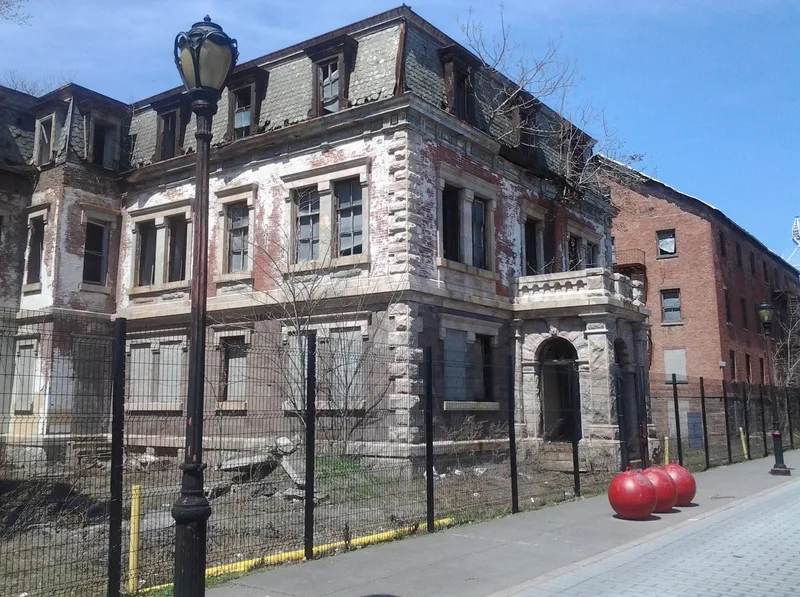
Overlooking the waterfront at 1 Bay Street in St. George, this group of buildings once served as the U.S. Light-House Depot for the Third District, which covered the coast from Maine to Delaware. A three-story brick and sandstone office building, designed by Alfred B. Mullett and built in 1868-71, anchors the complex. Its wings were added in 1901. Two Greek Revival brick warehouses, a small brick laboratory and a massive sandstone wall fronting buried oil vaults surround it. The depot was chosen in 1863 so that supplies, offices and experimental work could be combined in one place. Joseph Henry's department tested oils, wicks, fuels and fog signals, and the results improved lighthouse operations across the country. The office building is also valued as a refined example of French Second Empire government architecture, with a granite porch, quoins and a slate mansard roof. It is the only Mullett building left in New York City. The Coast Guard took over the site in 1939 and closed it in 1966.
Significance in brief: The depot conducted experiments that improved lighthouse equipment and set national standards for lighthouse operation, and it also served as a supply center. The Old Administration Building is an excellent small-scale government building in the French Second Empire style. It is the only surviving example of Mullett's work in New York City.
Machine-generated summary. This summary was generated by a language model from the official nomination document and has not been reviewed line by line by an editor. It may contain errors. Check the source document before relying on any detail. Source: nomination document (PDF) · National Archives catalog entry. NRHP reference 83001785, listed September 15, 1983. Summary generated October 2026 (model claude-sonnet-5-5, prompt v1.0-2026-10-29, confidence high).
Key facts
| Address | 1 Bay St., New York |
|---|---|
| County | Staten Island |
| Listed | September 15, 1983 |
| Reference number | 83001785 |
| Resource type | Building |
| Period of significance | c1840s-1901 |
| Architect / builder | Alfred B. Mullett; unknown |
| Architectural style | French Second Empire (office building); Greek Revival (warehouses) |
| Areas of significance | Science, Architecture |
| Level of significance | National |
| Status (as stated in the nomination) | Closed as a Coast Guard facility in 1966 and became surplus government property; title passed to New York City in 1982. Condition is listed as good and altered, and the property is marked unoccupied. |
| Acreage | 1.5 |
| Coordinates | 40.64123, -74.07455 (NPS GIS) |
What listing means for this property
National Register listing is honorary for a privately owned home: it does not by itself restrict what an owner may do with their own money, and it does not require public access. Restrictions come from local landmark or historic-district ordinances, which are separate (how they differ).
Owner-occupied houses are not eligible for the 20% federal rehabilitation tax credit, which applies to income-producing buildings, but many states offer credits for homeowners. Listing also opens the door to preservation easements and to buying a plaque. Start with what listing means for homeowners, renovating a listed house and selling one.
Noted as vacant in the nomination. Nomination documents can be decades old; current status may differ. If you are considering buying an empty listed property, read the due-diligence checklist.
General information, not legal or tax advice. Rules change; confirm with your State Historic Preservation Office or a qualified adviser.
Sources and further reading
- National Park Service, National Register of Historic Places database (snapshot May 2026), reference 83001785.
- Nomination form (PDF, National Archives) — catalog entry
- Wikipedia article (used for cross-checking only; text not reproduced here)
- Wikidata Q7588194
- This listing as JSON
Last updated October 2026. Found an error? See the editorial policy for how to report it.