Koon, Henry, House

Why it's listed
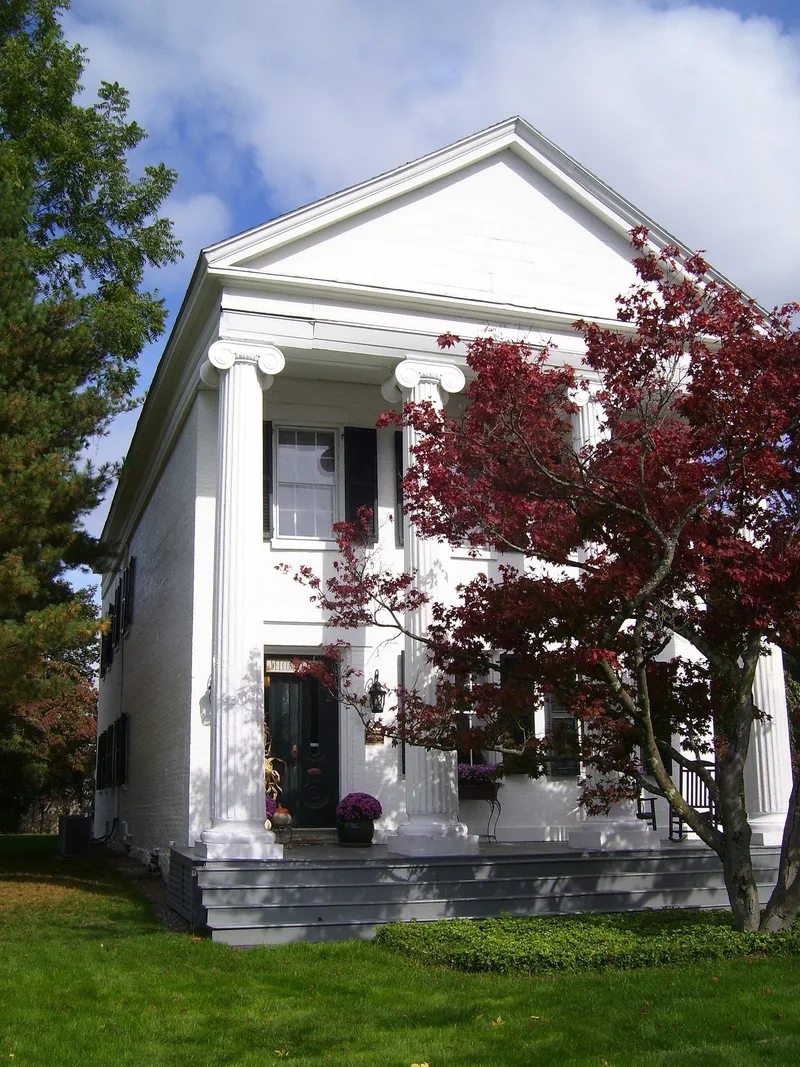
Built about 1830 by Henry Koon, this brick house at 171 Pawling Avenue in Troy is a two-story, side-hall-plan residence with a stone foundation and a gable roof. A monumental two-story portico with four fluted Ionic columns, a full entablature and a pediment dominates the front. Inside, matching double parlors, paneled pocket doors, molded trim and plaster walls survive largely intact. Later changes include an 1870 renovation that brought Italianate doors and a side porch, plus twentieth-century alterations such as a rear porch and a kitchen and bathroom. Koon was a lawyer, local figure, and a founder of the Universalist Church, though little else is known of his life. The house was listed for its architecture. It is presented as one of only several highly developed Greek Revival buildings in Troy, and as a once-rural farmhouse whose design reflects its owner's aspiration for elegance. It remains a single-family dwelling on about a third of an acre.
Significance in brief: The nomination argues the house is an outstanding and well-preserved example of Greek Revival domestic architecture in Troy, meeting Criterion C. It highlights a monumental two-story portico, a symmetrical composition, and largely intact interior features. It is described as an unusually well-articulated example of the rural Greek Revival tradition.
Machine-generated summary. This summary was generated by a language model from the official nomination document and has not been reviewed line by line by an editor. It may contain errors. Check the source document before relying on any detail. Source: nomination document (PDF) · National Archives catalog entry. NRHP reference 97000112, listed February 21, 1997. Summary generated October 2026 (model claude-sonnet-5-5, prompt v1.0-2026-10-29, confidence high).
Key facts
| Address | 171 Pawling Ave., Troy |
|---|---|
| County | Rensselaer County |
| Listed | February 21, 1997 |
| Reference number | 97000112 |
| Resource type | Building |
| Period of significance | ca.1830 |
| Architect / builder | Henry Koon (builder) |
| Architectural style | Mid-19th Century / Greek Revival |
| Criteria |
|
| Areas of significance | Architecture |
| Level of significance | Local |
| Status (as stated in the nomination) | Currently used as a single dwelling; some rooms were converted to an apartment and a kitchen and bathroom were added in the twentieth century. |
| Acreage | 0.9 |
| Coordinates | 42.71671, -73.66989 (NPS GIS) |
What listing means for this property
National Register listing is honorary for a privately owned home: it does not by itself restrict what an owner may do with their own money, and it does not require public access. Restrictions come from local landmark or historic-district ordinances, which are separate (how they differ).
Owner-occupied houses are not eligible for the 20% federal rehabilitation tax credit, which applies to income-producing buildings, but many states offer credits for homeowners. Listing also opens the door to preservation easements and to buying a plaque. Start with what listing means for homeowners, renovating a listed house and selling one.
General information, not legal or tax advice. Rules change; confirm with your State Historic Preservation Office or a qualified adviser.
Sources and further reading
- National Park Service, National Register of Historic Places database (snapshot May 2026), reference 97000112.
- Nomination form (PDF, National Archives) — catalog entry
- Wikipedia article (used for cross-checking only; text not reproduced here)
- Wikidata Q5724455
- This listing as JSON
Last updated October 2026. Found an error? See the editorial policy for how to report it.