Vander Ende-Onderdonk House Site
Also known as: Van Anda House; Van Enden House

Why it's listed
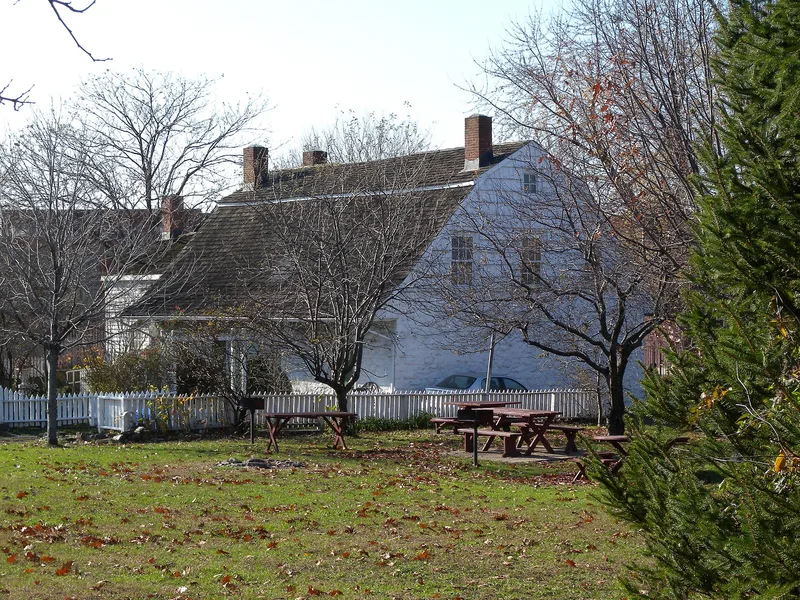
At 1820 Flushing Avenue in Ridgewood, Queens, a two-acre site preserves the remains of a stone, gambrel-roofed farmhouse built in 1713 by Paulus Vander-Ende. A fire in February 1975 gutted the house, leaving the dressed-stone shell, and a twentieth-century greenhouse factory and open rubble-strewn land share the lot. The property lay in a strip of Long Island once called the Disputed Territory, claimed by both Newtown and Bushwick from 1661 until the 1769 line between Kings and Queens Counties was fixed there. Ownership passed from the Smidt family through Stevenson, Titus, Vander-Ende, Beadel and, in 1821, Adrian Onderdonk. Later it served as a livery stable and scrap-glass depot, then as an office for the American Moninger Greenhouse Company. Archeological tests in 1975 found a foundation, cellar stairs and a cobblestone courtyard, with sealed eighteenth-century artifacts beneath. Together these remains document the change from farmstead to suburb to industry.
Significance in brief: The site is significant for its age, as a locus of seventeenth and eighteenth century Dutch and Huguenot settlement, and for its role as a reference point in the 1769 boundary settlement between Kings and Queens Counties. Archeological tests found intact features and deposits that document the site's use from the early eighteenth century through the twentieth. The form describes these remains as unique for this part of New York City.
Machine-generated summary. This summary was generated by a language model from the official nomination document and has not been reviewed line by line by an editor. It may contain errors. Check the source document before relying on any detail. Source: nomination document (PDF) · National Archives catalog entry. NRHP reference 77000975, listed January 31, 1977. Summary generated October 2026 (model claude-sonnet-5-5, prompt v1.0-2026-10-29, confidence medium).
Key facts
| Address | 1820 Flushing Ave., New York |
|---|---|
| County | Queens |
| Listed | January 31, 1977 |
| Reference number | 77000975 |
| Resource type | Site |
| Architect / builder | Paulus Vander-Ende (built the stone house in 1713) |
| Areas of significance | Historic - Non-Aboriginal, Exploration/Settlement, Politics/Government |
| Level of significance | Local |
| Status (as stated in the nomination) | The stone house was gutted by fire in February 1975; its ruins, a twentieth-century factory and open rubble-strewn land remain, and the site is fenced. The ownership status is listed as unoccupied. |
| Acreage | 2 |
| Coordinates | 40.71123, -73.91968 (NPS GIS) |
What listing means for this property
Sites (archaeological sites, battlefields, landscapes) are often listed with a restricted address to protect them from looting or disturbance. Listing is honorary for private owners; federal undertakings on or near the site go through Section 106 review, and state laws may protect burials and artefacts regardless of listing.
Noted as vacant in the nomination. Nomination documents can be decades old; current status may differ. If you are considering buying an empty listed property, read the due-diligence checklist.
General information, not legal or tax advice. Rules change; confirm with your State Historic Preservation Office or a qualified adviser.
Sources and further reading
- National Park Service, National Register of Historic Places database (snapshot May 2026), reference 77000975.
- Nomination form (PDF, National Archives) — catalog entry
- Wikipedia article (used for cross-checking only; text not reproduced here)
- Wikidata Q7914414
- This listing as JSON
Last updated October 2026. Found an error? See the editorial policy for how to report it.