Haskell House
Also known as: The Hermitage

Why it's listed
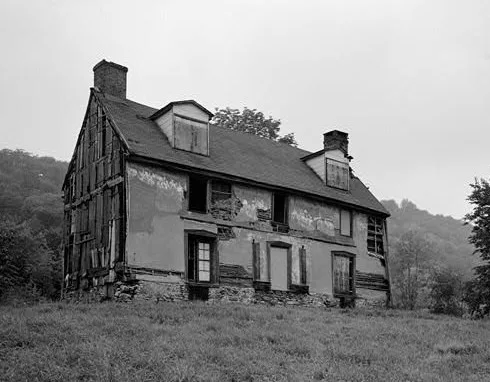
Sheltered by the rocky ledges of Snake Hill, this two-and-a-half-story house west of Route 32 in New Windsor was built by John Haskell, a military officer and steward to colonial governor Robert Hunter. A house stood here by 1729, and Haskell received a 2000-acre patent in 1724. Known as the Hermitage, it served as his country residence, where he reportedly conducted agricultural experiments. The first story is made of squared logs with half-capped corners, and the second story is braced frame filled with clay. The cellar is cut into the rock slope. Later owners included Evan Jones, the Dusenberry family and the Walter Vail family. During the Revolutionary War, two Army medical officers were quartered in the house. It was listed as a rare New York example of early log construction on a large scale. At the time of listing it was vacant and deteriorating, though much original fabric remained.
Significance in brief: The nomination presents it as a rare surviving New York example of early log construction applied on a large scale to a manor house. It was also a focal point in New Windsor's development and was the homestead of a 2000-acre patent granted to Haskell in 1724. During the Revolutionary War, Army medical officers were quartered there.
Machine-generated summary. This summary was generated by a language model from the official nomination document and has not been reviewed line by line by an editor. It may contain errors. Check the source document before relying on any detail. Source: nomination document (PDF) · National Archives catalog entry. NRHP reference 73001244, listed June 4, 1973. Summary generated October 2026 (model claude-sonnet-5-5, prompt v1.0-2026-10-29, confidence medium).
Key facts
| Address | W of New Windsor off NY 32, New Windsor |
|---|---|
| County | Orange County |
| Listed | June 4, 1973 |
| Reference number | 73001244 |
| Resource type | Building |
| Period of significance | 18th Century |
| Architect / builder | John Haskell |
| Areas of significance | Architecture |
| Level of significance | State |
| Status (as stated in the nomination) | Described as vacant, unoccupied and in deteriorating condition, with much original fabric intact. |
| Acreage | 5 |
| Coordinates | 41.48078, -74.04199 (NPS GIS) |
What listing means for this property
National Register listing is honorary for a privately owned home: it does not by itself restrict what an owner may do with their own money, and it does not require public access. Restrictions come from local landmark or historic-district ordinances, which are separate (how they differ).
Owner-occupied houses are not eligible for the 20% federal rehabilitation tax credit, which applies to income-producing buildings, but many states offer credits for homeowners. Listing also opens the door to preservation easements and to buying a plaque. Start with what listing means for homeowners, renovating a listed house and selling one.
Noted as vacant in the nomination. Nomination documents can be decades old; current status may differ. If you are considering buying an empty listed property, read the due-diligence checklist.
General information, not legal or tax advice. Rules change; confirm with your State Historic Preservation Office or a qualified adviser.
Sources and further reading
- National Park Service, National Register of Historic Places database (snapshot May 2026), reference 73001244.
- Nomination form (PDF, National Archives) — catalog entry
- Wikipedia article (used for cross-checking only; text not reproduced here)
- Wikidata Q5679207
- This listing as JSON
Last updated October 2026. Found an error? See the editorial policy for how to report it.