Edmonston House

Why it's listed
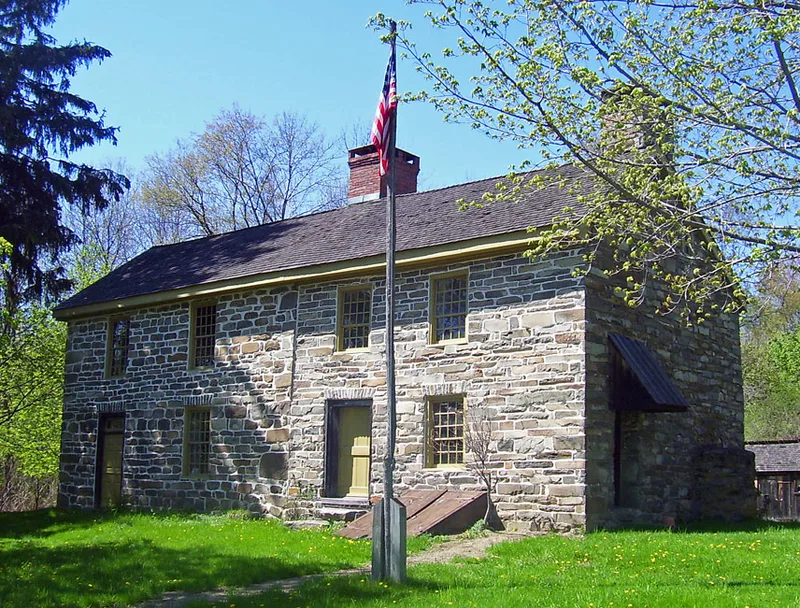
Edmonston House is a stone dwelling on Route 94 at Vails Gate in Orange County, New York. Its western section, and possibly the rear wing, dates to 1755, when William Edmonston, son of one of the area's earliest settlers, built it. A later addition made it a double house. The walls are coursed rubble, and the interior keeps mid-eighteenth-century features such as a paneled stairhall, heavy ceiling beams, large fireplaces, and a bake oven. The western half is more refined than the eastern. The house also has a Revolutionary War story. During the Continental Army's 1782-1783 encampment near New Windsor, Generals Horatio Gates and Arthur St. Clair stayed here, and the building held hospital stores. William Edmonston was later listed for house rent and damages owed by the Army. It remains one of few early stone houses left in the New Windsor area, and it shows how the region's first settlers lived and built.
Significance in brief: The house is a good example of eighteenth-century regional architecture, with two sections that invite comparison and retain much original fabric. During the Continental Army's 1782-1783 encampment it housed staff officers, including Generals Gates and St. Clair, and stored hospital supplies. The surrounding area is also likely to yield archaeological resources.
Machine-generated summary. This summary was generated by a language model from the official nomination document and has not been reviewed line by line by an editor. It may contain errors. Check the source document before relying on any detail. Source: nomination document (PDF) · National Archives catalog entry. NRHP reference 79001616, listed March 2, 1979. Summary generated October 2026 (model claude-sonnet-5-5, prompt v1.0-2026-10-29, confidence medium).
Key facts
| Address | NY 94, Vails Gate |
|---|---|
| County | Orange County |
| Listed | March 2, 1979 |
| Reference number | 79001616 |
| Resource type | Building |
| Period of significance | 1700-1799 |
| Architect / builder | William Edmonston |
| Areas of significance | Historic - Non-Aboriginal, Military, Politics/Government, Architecture |
| Level of significance | Local |
| Status (as stated in the nomination) | Listed as in good condition, altered, occupied, with missing or deteriorated elements carefully restored from physical evidence; owned by a historical association and used as a museum. |
| Acreage | 1 |
| Coordinates | 41.45329, -74.06215 (NPS GIS) |
What listing means for this property
National Register listing is honorary for a privately owned home: it does not by itself restrict what an owner may do with their own money, and it does not require public access. Restrictions come from local landmark or historic-district ordinances, which are separate (how they differ).
Owner-occupied houses are not eligible for the 20% federal rehabilitation tax credit, which applies to income-producing buildings, but many states offer credits for homeowners. Listing also opens the door to preservation easements and to buying a plaque. Start with what listing means for homeowners, renovating a listed house and selling one.
General information, not legal or tax advice. Rules change; confirm with your State Historic Preservation Office or a qualified adviser.
Sources and further reading
- National Park Service, National Register of Historic Places database (snapshot May 2026), reference 79001616.
- Nomination form (PDF, National Archives) — catalog entry
- Wikipedia article (used for cross-checking only; text not reproduced here)
- Wikidata Q5338975
- This listing as JSON
Last updated October 2026. Found an error? See the editorial policy for how to report it.