Meaker, C.G., Food Company Warehouse

Why it's listed
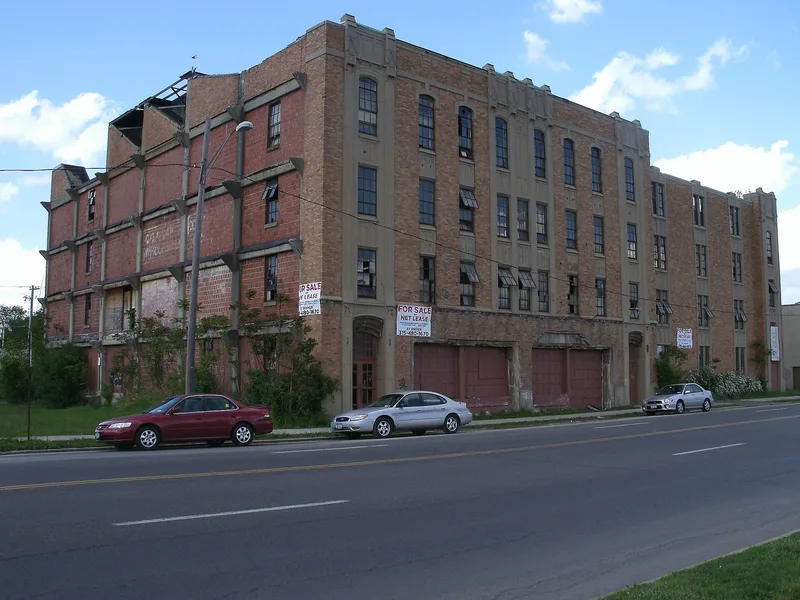
Rising four stories along Erie Boulevard West, west of downtown Syracuse, this 1930 warehouse was built for the C.G. Meaker Food Company of Auburn, which chose Syracuse for its rail and road connections. The boulevard was laid out in 1925 on the filled Erie Canal, and a railroad spur served the rear. The structure is poured-in-place reinforced concrete using the patented Turner mushroom column system, which allowed open floors, more daylight and fire resistance. Orange brick walls carry cast stone Collegiate Gothic details, including piers with quatrefoils and a shooting star motif. A brick-and-tile west wall was meant to be temporary, awaiting a west wing that the Depression prevented. Later tenants included Loblaw Groceries, Sears, Roebuck & Company and All State Stamping. The building has stood empty since 2003. It was listed for its association with Depression-era industrial development and as a refined example of industrial design.
Significance in brief: It is significant under Criterion A for its link to the Depression Era Development context within Syracuse's industrial resources, and under Criterion C as a refined example of early twentieth-century industrial architecture. It is described as an excellent local example of an early modern poured-in-place concrete building with unusually decorative facade detailing.
Machine-generated summary. This summary was generated by a language model from the official nomination document and has not been reviewed line by line by an editor. It may contain errors. Check the source document before relying on any detail. Source: nomination document (PDF) · National Archives catalog entry. NRHP reference 10000226, listed April 26, 2010. Summary generated October 2026 (model claude-sonnet-5-5, prompt v1.0-2026-10-29, confidence high).
Key facts
| Address | 538 Erie Blvd. W., Syracuse |
|---|---|
| County | Onondaga County |
| Listed | April 26, 2010 |
| Reference number | 10000226 |
| Resource type | Building |
| Period of significance | 1930 |
| Architectural style | Late 19th & 20th Century Revivals: Collegiate Gothic; Modern Movement |
| Criteria |
|
| Areas of significance | Architecture, Commerce |
| Level of significance | Local |
| Status (as stated in the nomination) | Vacant since 2003, when the last long-term occupant, All State Stamping, moved out. |
| Acreage | 0.9 |
| Coordinates | 43.05179, -76.16231 (NPS GIS) |
What listing means for this property
For an income-producing building, listing (individually or as a contributing building in a district) is the gateway to the 20% federal rehabilitation tax credit on qualified rehabilitation costs, often stackable with state credits. Work claiming the credit must follow the Secretary of the Interior's Standards and be approved in advance.
Listing does not restrict a private owner acting without federal money or permits; where federal funding or licensing is involved, Section 106 review applies.
Noted as vacant in the nomination. Nomination documents can be decades old; current status may differ. If you are considering buying an empty listed property, read the due-diligence checklist.
General information, not legal or tax advice. Rules change; confirm with your State Historic Preservation Office or a qualified adviser.
Sources and further reading
- National Park Service, National Register of Historic Places database (snapshot May 2026), reference 10000226.
- Nomination form (PDF, National Archives) — catalog entry
- Wikipedia article (used for cross-checking only; text not reproduced here)
- Wikidata Q5006105
- This listing as JSON
Last updated October 2026. Found an error? See the editorial policy for how to report it.