Grace Church

Why it's listed
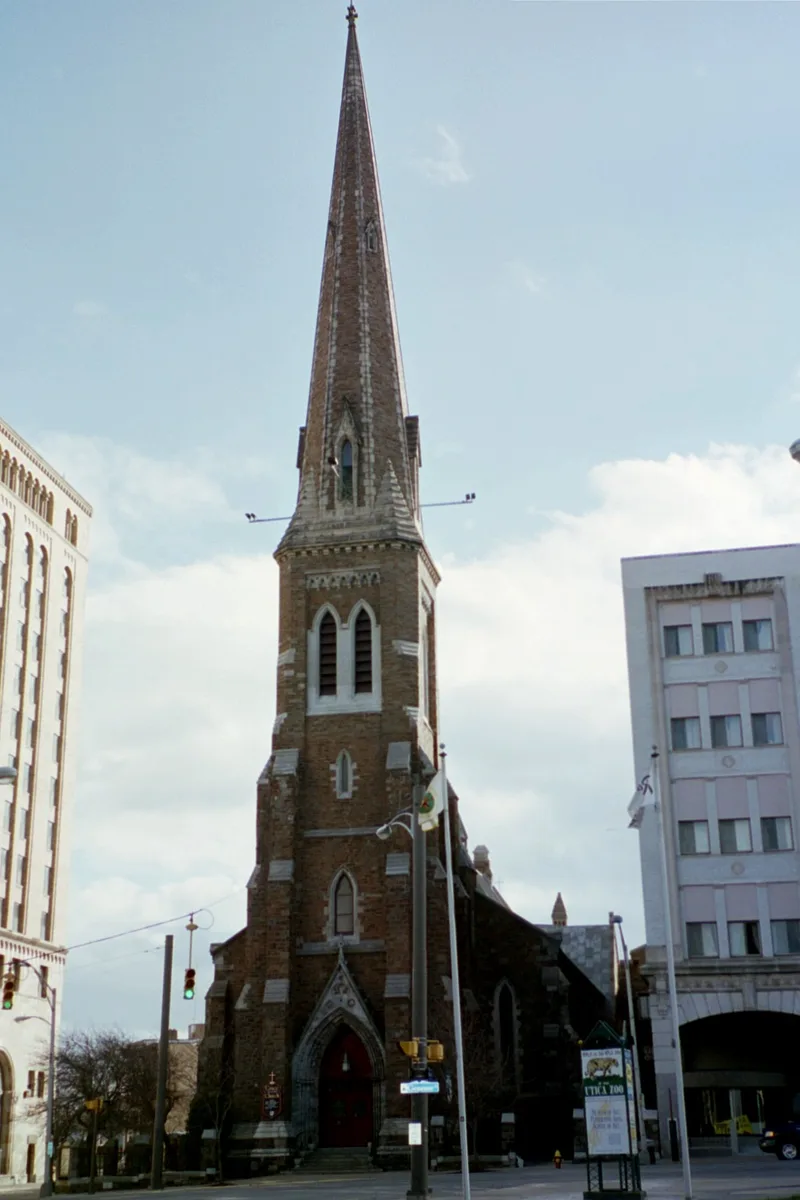
Grace Church is a limestone Gothic Revival Episcopal church at the corner of Genesee and Elizabeth Streets in downtown Utica. Built between 1856 and 1860 to plans by architect Richard Upjohn, it was funded largely by textile mill owner Alfred Munson and constructed by Welsh master mason William Jones. The tall, narrow building has a central tower, a long nave, shallow transepts and an apse. The tower and spire were finished in 1870 and 1875, then rebuilt in 1933 by Hobart B. Upjohn. Richard M. Upjohn enlarged the chancel in 1890. A Lady chapel and a 70-room parish house by F.B. and A. Ware replaced earlier outbuildings in 1926-28. Interior furnishings include work by Ralph Adams Cram, Louis C. Tiffany, Charles Connick, Henry Holiday and Karl Bitter. The complex was listed because it shows Upjohn's mid-career church design and records the growth of a prosperous urban parish over several decades, and it has been in continuous use since 1860.
Significance in brief: The complex is argued to be a fully intact example of an urban Episcopal church complex built in stages from 1856 to 1933, notable for consistently high design quality. It represents Richard Upjohn's mid-career masonry Gothic Revival work, with later contributions by his son and grandson and by the firm F.B. and A. Ware, plus furnishings by noted artists. It also documents the growth of the Episcopal Church and a prosperous congregation.
Machine-generated summary. This summary was generated by a language model from the official nomination document and has not been reviewed line by line by an editor. It may contain errors. Check the source document before relying on any detail. Source: nomination document (PDF) · National Archives catalog entry. NRHP reference 97000419, listed May 23, 1997. Summary generated October 2026 (model claude-sonnet-5-5, prompt v1.0-2026-10-29, confidence high).
Key facts
| Address | 193 Genesee St., Utica |
|---|---|
| County | Oneida County |
| Listed | May 23, 1997 |
| Reference number | 97000419 |
| Resource type | Building |
| Period of significance | 1856-1933 |
| Architect / builder | Richard Upjohn, architect; Richard M. Upjohn, architect; Hobart B. Upjohn, architect; F.B. and A. Ware, architect; William Jones, builder |
| Architectural style | Mid-19th Century / Gothic Revival |
| Criteria |
|
| Areas of significance | Community Planning and Development, Religion, Architecture |
| Level of significance | State |
| Status (as stated in the nomination) | In continuous use as a church since its consecration in 1860; retains a very high degree of integrity. |
| Acreage | 1 |
| Within district | Downtown Genessee Street Historic District |
| Coordinates | 43.10079, -75.23088 (NPS GIS) |
What listing means for this property
Religious properties are listed for their architectural or historical significance, not their religious use. Listing is honorary and does not restrict the congregation's use of the building. The federal rehabilitation credit is generally unavailable unless part of the building is income-producing; some state programmes and preservation grants do cover religious buildings. Federal funding or permits trigger Section 106 review.
General information, not legal or tax advice. Rules change; confirm with your State Historic Preservation Office or a qualified adviser.
Sources and further reading
- National Park Service, National Register of Historic Places database (snapshot May 2026), reference 97000419.
- Nomination form (PDF, National Archives) — catalog entry
- Wikipedia article (used for cross-checking only; text not reproduced here)
- Wikidata Q5591046
- This listing as JSON
Last updated October 2026. Found an error? See the editorial policy for how to report it.