Calvary Episcopal Church (former)

Why it's listed
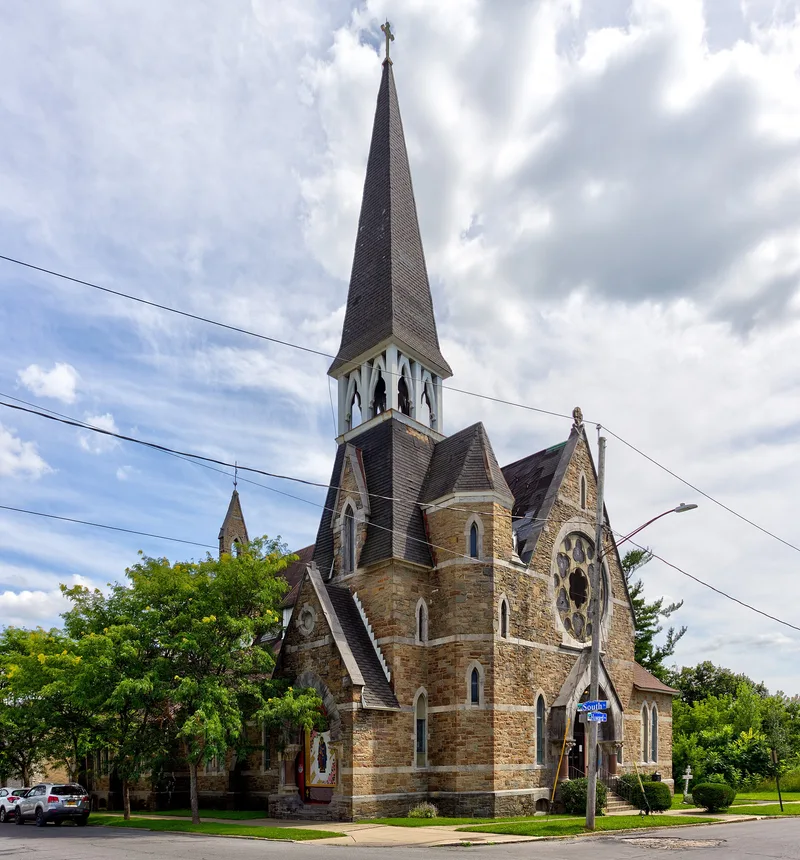
Built between 1870 and 1872 at Howard Avenue and South Street in Utica's Corn Hill neighborhood, this stone church was designed for an Episcopal mission congregation founded in 1850. English-born builder Thomas Birt prepared the original scheme, and New York City architect Henry M. Congdon refined and executed it. The building follows English parish church models of the late Middle Ages, with an asymmetrical cruciform plan, quarry-faced trap rock walls, buttresses, a 15-foot rose window and a corner tower with an open belfry and steeple. Inside, carved posts and Gothic arches support a hammer-beam and timber-truss ceiling. Memorial stained glass windows, installed circa 1872-1890, are also considered notable. The Episcopal congregation ended services in 1995, and the original organ and furnishings were sold off. Since the late 1990s an Italo-Greek Orthodox congregation has used the church as a cathedral, and it was listed for its architectural significance.
Significance in brief: The nomination argues it is a distinguished and substantially intact example of Late Victorian English Gothic church architecture in Utica. It reflects the Ecclesiological ideals favored by Episcopalians after the Civil War. It is also noted for its memorial stained glass windows, installed circa 1872-1890.
Machine-generated summary. This summary was generated by a language model from the official nomination document and has not been reviewed line by line by an editor. It may contain errors. Check the source document before relying on any detail. Source: nomination document (PDF) · National Archives catalog entry. NRHP reference 08000595, listed July 3, 2008. Summary generated October 2026 (model claude-sonnet-5-5, prompt v1.0-2026-10-29, confidence high).
Key facts
| Address | 1101 Howard Ave, Utica |
|---|---|
| County | Oneida County |
| Listed | July 3, 2008 |
| Reference number | 08000595 |
| Resource type | Building |
| Period of significance | 1870-circa 1890 |
| Architect / builder | Thomas Birt (architect); Henry M. Congdon (architect) |
| Architectural style | Late Victorian/Gothic Revival |
| Criteria |
|
| Areas of significance | Architecture |
| Level of significance | Local |
| Status (as stated in the nomination) | Vacated by its Episcopal congregation in 1995; since the late 1990s it has been used as the Cathedral of the Theotokos of Great Grace by an Italo-Greek Orthodox congregation. The original pews, organ and furniture were sold. |
| Acreage | 0.9 |
| Coordinates | 43.09684, -75.23026 (NPS GIS) |
What listing means for this property
Religious properties are listed for their architectural or historical significance, not their religious use. Listing is honorary and does not restrict the congregation's use of the building. The federal rehabilitation credit is generally unavailable unless part of the building is income-producing; some state programmes and preservation grants do cover religious buildings. Federal funding or permits trigger Section 106 review.
General information, not legal or tax advice. Rules change; confirm with your State Historic Preservation Office or a qualified adviser.
Sources and further reading
- National Park Service, National Register of Historic Places database (snapshot May 2026), reference 08000595.
- Nomination form (PDF, National Archives) — catalog entry
- Wikipedia article (used for cross-checking only; text not reproduced here)
- Wikidata Q5024183
- This listing as JSON
Last updated October 2026. Found an error? See the editorial policy for how to report it.