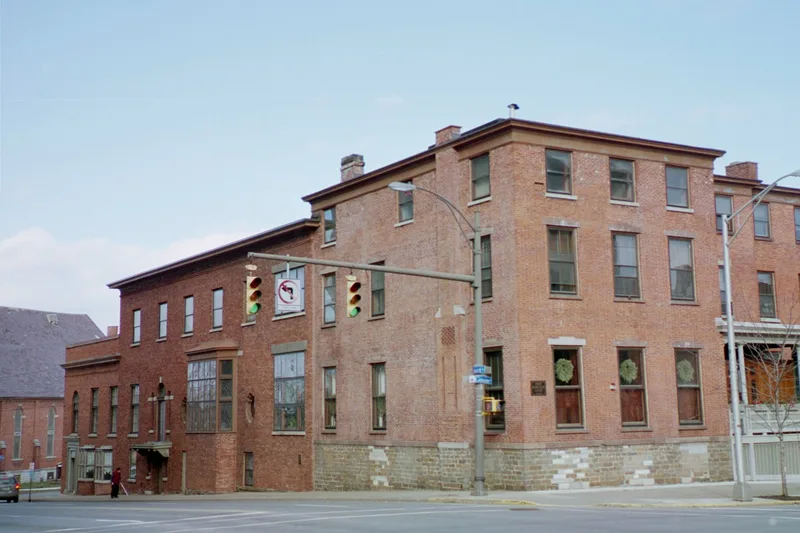
Fort Schuyler Club Building

Why it's listed
Built in 1830 as a three-story Federal style brick townhouse for canal contractor Samuel Farwell, this building at Genesee and Court Streets in downtown Utica became the Fort Schuyler Club's home in 1883. The club was a social organization of the city's business and professional leaders, and early members included a governor, a vice president and a Supreme Court justice. The club altered and enlarged the house over several decades. A fire in January 1899 led to additions through 1902, including a ballroom, a Palm Room and a Ladies' Annex, and a large western addition followed in 1929. Interiors show Colonial Revival, Arts and Crafts and Jacobean-Elizabethan influences, such as the oak-paneled Oak Room with its molded plaster ceiling. The building is reported to have been the first in Utica to have electric lights, installed in 1888. It is valued as a rare, largely intact club building and a landmark on Genesee Street, and it still serves as a clubhouse.
Significance in brief: The nomination argues that it is a rare and substantially intact late 19th and early 20th century social club building in downtown Utica. It has served as a gathering place for the city's business and civic leaders since 1883. Its phased additions and interiors show a succession of architectural styles, including Federal, Colonial Revival and Arts and Crafts. It remains a landmark on Genesee Street.
Machine-generated summary. This summary was generated by a language model from the official nomination document and has not been reviewed line by line by an editor. It may contain errors. Check the source document before relying on any detail. Source: nomination document (PDF) · National Archives catalog entry. NRHP reference 04000436, listed May 12, 2004. Summary generated October 2026 (model claude-sonnet-5-5, prompt v1.0-2026-10-29, confidence high).
Key facts
| Address | 254 Genesee St., Utica |
|---|---|
| County | Oneida County |
| Listed | May 12, 2004 |
| Reference number | 04000436 |
| Resource type | Building |
| Period of significance | 1830-1929 |
| Architectural style | Early Republic/Federal |
| Criteria |
|
| Areas of significance | Social History, Architecture |
| Level of significance | Local |
| Status (as stated in the nomination) | Still in use as a social clubhouse; the club's membership continues today. |
| Acreage | 0.9 |
| Within district | Downtown Genessee Street Historic District |
| Coordinates | 43.09986, -75.23497 (NPS GIS) |
What listing means for this property
For an income-producing building, listing (individually or as a contributing building in a district) is the gateway to the 20% federal rehabilitation tax credit on qualified rehabilitation costs, often stackable with state credits. Work claiming the credit must follow the Secretary of the Interior's Standards and be approved in advance.
Listing does not restrict a private owner acting without federal money or permits; where federal funding or licensing is involved, Section 106 review applies.
General information, not legal or tax advice. Rules change; confirm with your State Historic Preservation Office or a qualified adviser.
Sources and further reading
- National Park Service, National Register of Historic Places database (snapshot May 2026), reference 04000436.
- Nomination form (PDF, National Archives) — catalog entry
- Wikipedia article (used for cross-checking only; text not reproduced here)
- Wikidata Q5471995
- This listing as JSON
Last updated October 2026. Found an error? See the editorial policy for how to report it.