Reformed Dutch Church of Stone Arabia
Also known as: Stone Arabia Reformed Church

Why it's listed
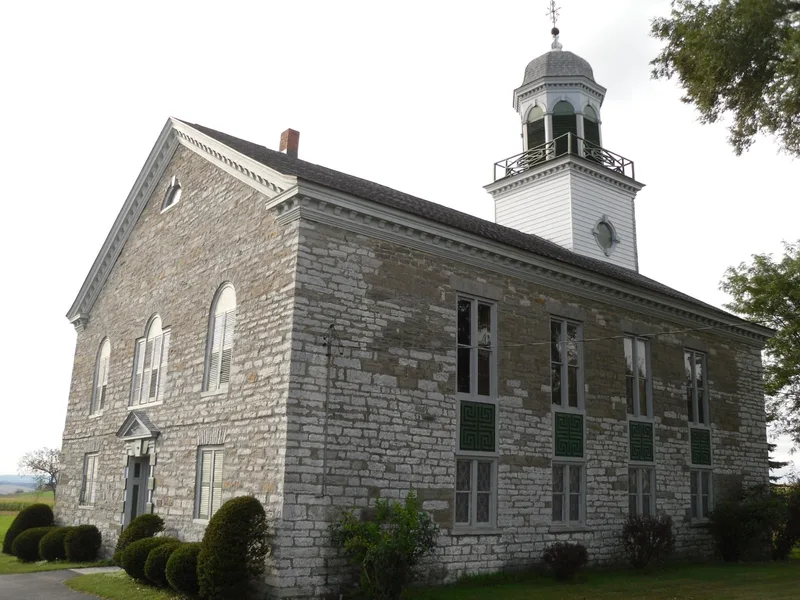
Standing at a rural crossroads about four miles north of the Mohawk River, this limestone church was built in 1787-1789 for the Reformed Dutch congregation of Stone Arabia. Palatine settlers, some Lutheran and some Dutch Reformed, had farmed the area since the early eighteenth century. After separate churches built in 1744 were burned in a Tory raid in 1780, the Reformed congregation rebuilt once peace returned. Philip Schuyler is recorded as the builder, and the cost was $3,378. The rectangular building has a Palladian window, stone arched lintels, a fine boxed cornice and an octagonal belfry that may have been added later. Inside, a single large space has side galleries on fluted wooden columns. Changes recorded in 1840 included closing an east entrance and a high ceiling. It is one of few stone buildings west of Schenectady surviving from before 1790. The listing also covers the old cemetery just west of the church.
Significance in brief: It is one of a very few stone buildings west of Schenectady that remain from before 1790, and it retains enough original and very old fabric to rank among the more important survivors of that period. It also recalls the Palatine settlers who farmed the area during a time of danger and turmoil. Its sophisticated Georgian design is unusual for a rural setting.
Machine-generated summary. This summary was generated by a language model from the official nomination document and has not been reviewed line by line by an editor. It may contain errors. Check the source document before relying on any detail. Source: nomination document (PDF) · National Archives catalog entry. NRHP reference 77000951, listed September 14, 1977. Summary generated October 2026 (model claude-sonnet-5-5, prompt v1.0-2026-10-29, confidence high).
Key facts
| Address | E of Nelliston on NY 10, Nelliston |
|---|---|
| County | Montgomery County |
| Listed | September 14, 1977 |
| Reference number | 77000951 |
| Resource type | Building |
| Period of significance | 1787-89 |
| Architect / builder | Philip Schuyler (recorded as builder; attributed to) |
| Architectural style | Georgian |
| Areas of significance | Exploration/Settlement, Architecture |
| Level of significance | Local |
| Status (as stated in the nomination) | Still in use as a church; the form lists present use as religious and the data sheet gives function now as church. |
| Acreage | 0.9 |
| Coordinates | 42.94248, -74.55613 (NPS GIS) |
What listing means for this property
Religious properties are listed for their architectural or historical significance, not their religious use. Listing is honorary and does not restrict the congregation's use of the building. The federal rehabilitation credit is generally unavailable unless part of the building is income-producing; some state programmes and preservation grants do cover religious buildings. Federal funding or permits trigger Section 106 review.
General information, not legal or tax advice. Rules change; confirm with your State Historic Preservation Office or a qualified adviser.
Sources and further reading
- National Park Service, National Register of Historic Places database (snapshot May 2026), reference 77000951.
- Nomination form (PDF, National Archives) — catalog entry
- Wikipedia article (used for cross-checking only; text not reproduced here)
- Wikidata Q7307510
- This listing as JSON
Last updated October 2026. Found an error? See the editorial policy for how to report it.