Van Alstyne House
Also known as: Fort Rensselaer Club

Why it's listed
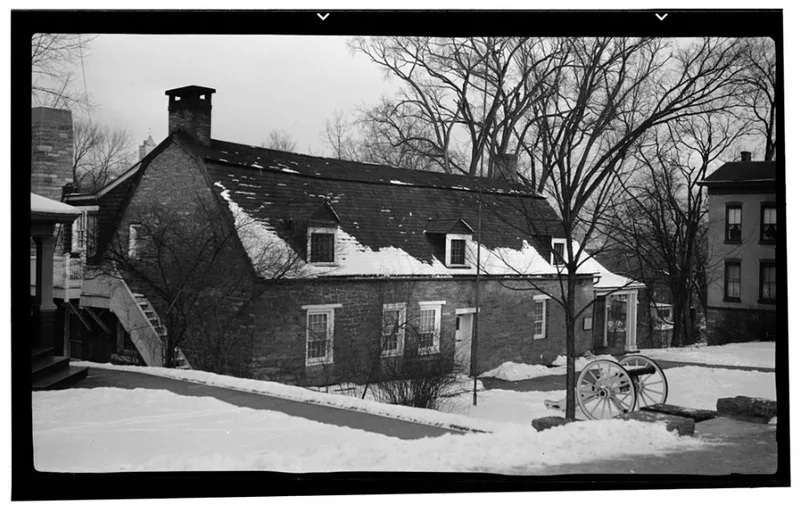
Set on a sloping lot above Canajoharie Creek, this long, low stone house with a steep gambrel roof is one of the few surviving Dutch Colonial buildings in the Mohawk Valley. Family tradition dates it to 1730 or 1749, though no firm documentation exists. It was associated with the Van Alstyne family, early settlers and traders. By the 1880s it had decayed into a tenant house and was threatened with demolition. A local group, the Mohawk Valley Historical Society, took ownership in 1888 and restored it, an early preservation effort. Since 1902 it has housed the Fort Rensselaer Club, supported by the Beech Nut Packing Company. In 1915 architect Bryant Fleming of Buffalo designed a rear addition that doubled the building's size, using matching stone and simple beamed interiors to echo the old house. Original features include coursed fieldstone walls, brick end chimneys, wainscoting and overmantels. The house also remains a community landmark.
Significance in brief: The nomination argues it is a rare surviving eighteenth-century Dutch Colonial house in the Mohawk Valley, and likely the only gambrel-roofed one west of Schenectady. It is linked to the Van Alstyne family, early settlers and traders. Its 1880s restoration by the Mohawk Valley Historical Society was an early preservation project, and the 1915 addition is notable for its sensitivity to the original fabric.
Machine-generated summary. This summary was generated by a language model from the official nomination document and has not been reviewed line by line by an editor. It may contain errors. Check the source document before relying on any detail. Source: nomination document (PDF) · National Archives catalog entry. NRHP reference 83001711, listed September 8, 1983. Summary generated October 2026 (model claude-sonnet-5-5, prompt v1.0-2026-10-29, confidence high).
Key facts
| Address | Moyer St., Canajoharie |
|---|---|
| County | Montgomery County |
| Listed | September 8, 1983 |
| Reference number | 83001711 |
| Resource type | Building |
| Period of significance | 1700-1799, 1800-1899, 1900- (specific dates 1749, 1888, 1915) |
| Architect / builder | 1915 addition: Bryant Fleming |
| Architectural style | Dutch Colonial |
| Areas of significance | Exploration/Settlement, Architecture |
| Level of significance | Local |
| Status (as stated in the nomination) | Occupied and in use as a private social club (Fort Rensselaer Club); condition marked good and altered. |
| Acreage | 0.2 |
| Within district | Canajoharie Historic District |
| Coordinates | 42.90337, -74.57234 (NPS GIS) |
What listing means for this property
National Register listing is honorary for a privately owned home: it does not by itself restrict what an owner may do with their own money, and it does not require public access. Restrictions come from local landmark or historic-district ordinances, which are separate (how they differ).
Owner-occupied houses are not eligible for the 20% federal rehabilitation tax credit, which applies to income-producing buildings, but many states offer credits for homeowners. Listing also opens the door to preservation easements and to buying a plaque. Start with what listing means for homeowners, renovating a listed house and selling one.
General information, not legal or tax advice. Rules change; confirm with your State Historic Preservation Office or a qualified adviser.
Sources and further reading
- National Park Service, National Register of Historic Places database (snapshot May 2026), reference 83001711.
- Nomination form (PDF, National Archives) — catalog entry
- Wikipedia article (used for cross-checking only; text not reproduced here)
- Wikidata Q7913114
- This listing as JSON
Last updated October 2026. Found an error? See the editorial policy for how to report it.