Wagner, Webster, House

Why it's listed
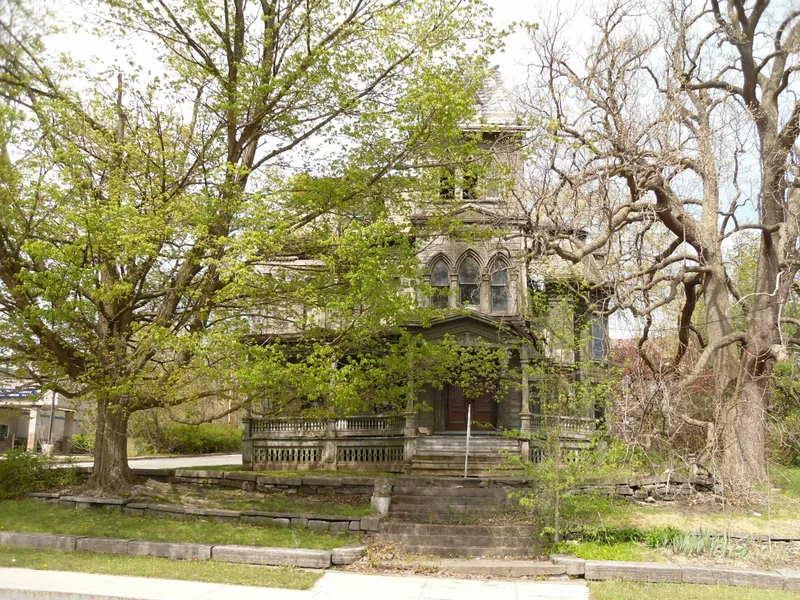
Perched on a ridge above the Mohawk River, the railroad tracks and the old Mohawk Turnpike at Palatine Bridge, this large frame house was completed in 1876 for Webster Wagner. Wagner, a railroad station agent turned inventor, created the sleeping car, the drawing room coach and a raised roof ventilator for rail cars, and later served in the New York State Assembly and Senate. Syracuse architect Horatio Nelson White designed the house, which served as the family's summer home. The two-and-a-half-story main block has a mansard roof, a three-story entrance tower, polygonal bays, a veranda and a deep piazza, all with heavy, bold detail. Inside, the parlors, dining room and library have mahogany and walnut burl woodwork, marble mantels and period lighting fixtures. Original touches include frosted entrance glass bearing a "W". The house was listed for its architecture and its link to Wagner's railroad career.
Significance in brief: The nomination presents the house as a well-preserved post-Civil War mansion reflecting the ambitions of a self-made millionaire inventor. It is closely tied to the Railroad Age, since Wagner invented the sleeping car, the drawing room car and a raised ventilating roof for railroad cars. It is also noted for its varied massing, mansard roof and rich interior woodwork.
Machine-generated summary. This summary was generated by a language model from the official nomination document and has not been reviewed line by line by an editor. It may contain errors. Check the source document before relying on any detail. Source: nomination document (PDF) · National Archives catalog entry. NRHP reference 73001210, listed March 7, 1973. Summary generated October 2026 (model claude-sonnet-5-5, prompt v1.0-2026-10-29, confidence high).
Key facts
| Address | E. Grand St., Palatine Bridge |
|---|---|
| County | Montgomery County |
| Listed | March 7, 1973 |
| Reference number | 73001210 |
| Resource type | Building |
| Period of significance | 19th Century (1876) |
| Architect / builder | Horatio Nelson White (architect); built by Webster Wagner |
| Areas of significance | Architecture, Invention |
| Level of significance | State |
| Status (as stated in the nomination) | Condition is marked excellent and unaltered on the original site; the house is occupied and used as a residence and a store for old phonographs and records. |
| Acreage | 1 |
| Within district | Palatine Bridge Historic District |
| Coordinates | 42.91083, -74.56910 (NPS GIS) |
What listing means for this property
National Register listing is honorary for a privately owned home: it does not by itself restrict what an owner may do with their own money, and it does not require public access. Restrictions come from local landmark or historic-district ordinances, which are separate (how they differ).
Owner-occupied houses are not eligible for the 20% federal rehabilitation tax credit, which applies to income-producing buildings, but many states offer credits for homeowners. Listing also opens the door to preservation easements and to buying a plaque. Start with what listing means for homeowners, renovating a listed house and selling one.
General information, not legal or tax advice. Rules change; confirm with your State Historic Preservation Office or a qualified adviser.
Sources and further reading
- National Park Service, National Register of Historic Places database (snapshot May 2026), reference 73001210.
- Nomination form (PDF, National Archives) — catalog entry
- Wikipedia article (used for cross-checking only; text not reproduced here)
- Wikidata Q7978978
- This listing as JSON
Last updated October 2026. Found an error? See the editorial policy for how to report it.