Trinity Lutheran Church and Cemetery

Why it's listed
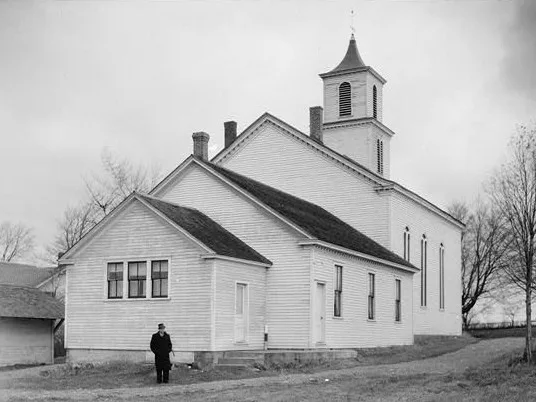
Set on a 20.3-acre glebe lot along Route 10 in Stone Arabia, this Lutheran church and cemetery reflect nearly three centuries of settlement by Palatine Germans. The congregation bought the land in 1729 and built a log church there. Raiders burned that church in 1780, and construction of the present timber-frame building began in 1791 under Rev. Philip Jacob Grotz; it was dedicated in 1792. The gable-roofed church shows vernacular Federal features, including a modillion cornice and a two-stage bell tower. A major renovation in 1882 added round-arched trim, stained glass, and a pipe organ, giving it Italianate character. Aluminum siding was added in the early 1960s. The adjoining cemetery, established in the early eighteenth century, holds about 25 marked graves, mostly plain fieldstone markers, the earliest dated 1752. The property was listed for its role in local settlement and its architecture, and the congregation still worships there.
Significance in brief: The nomination cites Criteria A and C. The church is an intact, representative example of vernacular Federal church architecture with Italianate modifications from an 1882 renovation. The property also documents the settlement of Stone Arabia by Palatine Germans, and its early cemetery is called a rare example of its type and period.
Machine-generated summary. This summary was generated by a language model from the official nomination document and has not been reviewed line by line by an editor. It may contain errors. Check the source document before relying on any detail. Source: nomination document (PDF) · National Archives catalog entry. NRHP reference 04001440, listed January 5, 2005. Summary generated October 2026 (model claude-sonnet-5-5, prompt v1.0-2026-10-29, confidence high).
Key facts
| Address | 5430 NY 10, Stone Arabia |
|---|---|
| County | Montgomery County |
| Listed | January 5, 2005 |
| Reference number | 04001440 |
| Resource type | Building |
| Period of significance | 1729-1931 |
| Architectural style | Mid-19th Century/Italianate (vernacular Federal building with later Italianate modifications) |
| Criteria |
|
| Areas of significance | Exploration/Settlement, Architecture |
| Level of significance | Local |
| Status (as stated in the nomination) | The church remains in use as a center of religious and community life with a small but active congregation. |
| Acreage | 20.3 |
| Coordinates | 42.94118, -74.56257 (NPS GIS) |
What listing means for this property
Religious properties are listed for their architectural or historical significance, not their religious use. Listing is honorary and does not restrict the congregation's use of the building. The federal rehabilitation credit is generally unavailable unless part of the building is income-producing; some state programmes and preservation grants do cover religious buildings. Federal funding or permits trigger Section 106 review.
General information, not legal or tax advice. Rules change; confirm with your State Historic Preservation Office or a qualified adviser.
Sources and further reading
- National Park Service, National Register of Historic Places database (snapshot May 2026), reference 04001440.
- Nomination form (PDF, National Archives) — catalog entry
- Wikipedia article (used for cross-checking only; text not reproduced here)
- Wikidata Q14707509
- This listing as JSON
Last updated October 2026. Found an error? See the editorial policy for how to report it.