Union Square
Also known as: Union Square Park

Why it's listed
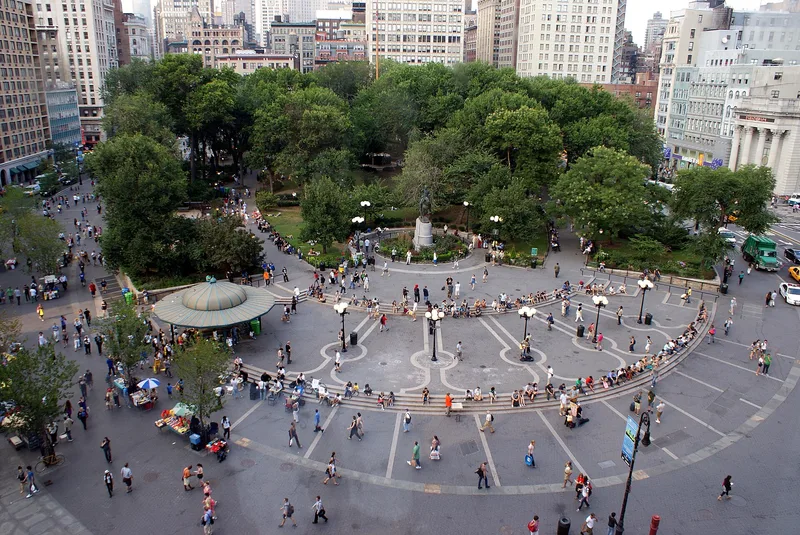
Union Square is a public park in lower mid-town Manhattan, bounded by East 14th and East 17th Streets. Named for its position at the junction of Broadway and the Bowery Road, it was laid out as Union Place in 1815 and opened as a park in 1839. It later became a public space with a pavilion at its north end. The nomination treats the park and its surrounding streets as one contributing site because of their link to the first Labor Day parade, held on September 5, 1882, by the Central Labor Union. That march ended at the square, and the following twelve years of effort led to national legislation for a labor holiday. The park also holds notable commemorative sculpture, including statues of Washington, Lincoln and Lafayette and the James Fountain, dating from 1856 to 1881. A 1930s redesign raised the ground level and moved several statues. City restoration work took place from 1987 to 1993.
Significance in brief: The nomination argues that the square is nationally significant in American labor history. It was the destination of the first Labor Day parade on September 5, 1882, and the focus of the following twelve years of effort that led to national legislation recognizing a day for labor. The square has also long hosted parades, mass meetings and labor demonstrations.
Machine-generated summary. This summary was generated by a language model from the official nomination document and has not been reviewed line by line by an editor. It may contain errors. Check the source document before relying on any detail. Source: nomination document (PDF) · National Archives catalog entry. NRHP reference 97001678, listed December 9, 1997. Summary generated October 2026 (model claude-sonnet-5-5, prompt v1.0-2026-10-29, confidence medium).
Key facts
| Address | Bounded by E 14th & E 17th Sts. and Union Square East & Union Square West, New York |
|---|---|
| County | Manhattan |
| Listed | December 9, 1997 |
| Reference number | 97001678 |
| Resource type | Site |
| Period of significance | 1882-1894 |
| Architect / builder | Sculptors: Frederic Auguste Bartholdi, Henry Kirke Brown, Hunt Diedrich, Karl Adolf Donndorf, John Quincy Adams Ward |
| Criteria |
|
| Areas of significance | Social History |
| Level of significance | National |
| National Historic Landmark | Yes, designated September 9, 1997 |
| Status (as stated in the nomination) | The park was restored and rehabilitated by the city between 1987 and 1993. It is described as well maintained and heavily used, with a greenmarket held in the north plaza on Wednesdays and Saturdays. |
| Acreage | 8.6 |
| Coordinates | 40.73561, -73.99053 (NPS GIS) |
What listing means for this property
Sites (archaeological sites, battlefields, landscapes) are often listed with a restricted address to protect them from looting or disturbance. Listing is honorary for private owners; federal undertakings on or near the site go through Section 106 review, and state laws may protect burials and artefacts regardless of listing.
General information, not legal or tax advice. Rules change; confirm with your State Historic Preservation Office or a qualified adviser.
Sources and further reading
- National Park Service, National Register of Historic Places database (snapshot May 2026), reference 97001678.
- Nomination form (PDF, National Archives) — catalog entry
- Wikipedia article (used for cross-checking only; text not reproduced here)
- Wikidata Q110007
- This listing as JSON
Last updated October 2026. Found an error? See the editorial policy for how to report it.