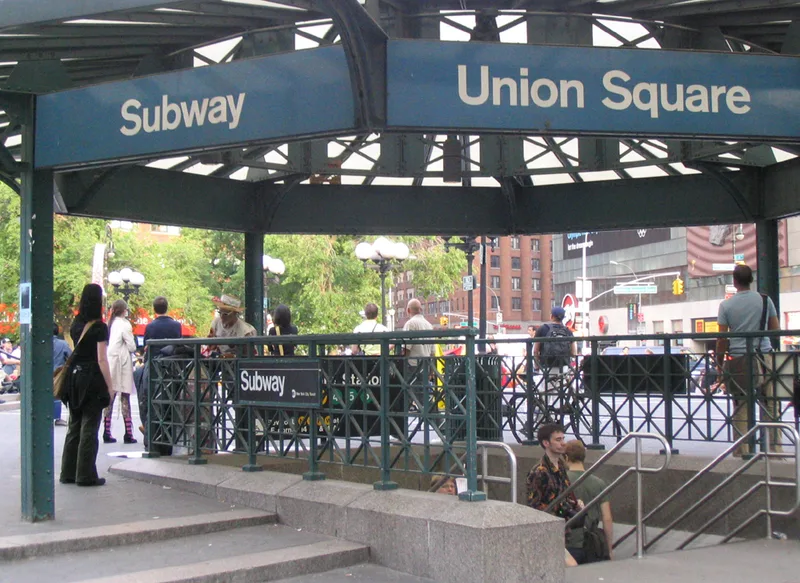
14th Street-Union Square Subway Station (IRT; Dual System BMT)

Why it's listed
This underground station at Broadway, Fourth Avenue and East 14th Street in Manhattan combines three subway stations built over twenty years. The original IRT station opened in 1904, followed by the BMT Broadway/4th Avenue line in 1917 and the Canarsie Line in 1924. All were built by cut-and-cover construction. The IRT portion was engineered by William Barclay Parsons, with architecture and decoration by Heins & LaFarge, who used faience plaques showing an eagle and the number 14. The BMT portions were designed under Squire J. Vickers, using white ceramic tile and colorful mosaic friezes, including a medallion based on a scene of Broadway and the Bowery Road in 1828. The station was heavily renovated in the 1980s and 1990s, yet original elements survive and are marked by red frames. It was listed for its role as a transit hub serving the Union Square area and for its engineering, architecture and art.
Significance in brief: The nomination argues the station is significant under Criterion A for transportation, community planning and development, and social history, as a major transit hub. It also meets Criterion C for engineering, architecture and art, with surviving IRT faience and BMT mosaic work by Heins & LaFarge and Squire J. Vickers. Despite major renovations, it retains a relatively high degree of integrity.
Machine-generated summary. This summary was generated by a language model from the official nomination document and has not been reviewed line by line by an editor. It may contain errors. Check the source document before relying on any detail. Source: nomination document (PDF) · National Archives catalog entry. NRHP reference 05000671, listed July 6, 2005. Summary generated October 2026 (model claude-sonnet-5-5, prompt v1.0-2026-10-29, confidence high).
Key facts
| Address | Broadway, Fourth ave., and E. 14th St., New York |
|---|---|
| County | Manhattan |
| Listed | July 6, 2005 |
| Reference number | 05000671 |
| Resource type | Structure |
| Period of significance | 1904-1924 |
| Architect / builder | Parsons, William Barclay (engineer); Craven, Alfred (engineer); Heins & LaFarge (architects); Vickers, Squire J. (architect) |
| Architectural style | Late 19th & 20th Century Revivals/Beaux-Arts; Other/Arts & Crafts |
| Criteria |
|
| Areas of significance | Transportation, Architecture, Art, Engineering, Community Planning and Development, Social History |
| Level of significance | Local |
| Status (as stated in the nomination) | Still in use as a subway station; renovated in the late 1980s and in 1993-1994, with some original tile and mosaic elements preserved and marked by red frames. |
| Acreage | 0.9 |
| Coordinates | 40.73548, -73.99070 (NPS GIS) |
What listing means for this property
For an income-producing building, listing (individually or as a contributing building in a district) is the gateway to the 20% federal rehabilitation tax credit on qualified rehabilitation costs, often stackable with state credits. Work claiming the credit must follow the Secretary of the Interior's Standards and be approved in advance.
Listing does not restrict a private owner acting without federal money or permits; where federal funding or licensing is involved, Section 106 review applies.
General information, not legal or tax advice. Rules change; confirm with your State Historic Preservation Office or a qualified adviser.
Sources and further reading
- National Park Service, National Register of Historic Places database (snapshot May 2026), reference 05000671.
- Nomination form (PDF, National Archives) — catalog entry
- Wikipedia article (used for cross-checking only; text not reproduced here)
- Wikidata Q2631031
- This listing as JSON
Last updated October 2026. Found an error? See the editorial policy for how to report it.