Students' Hall
Also known as: Barnard Hall

Why it's listed
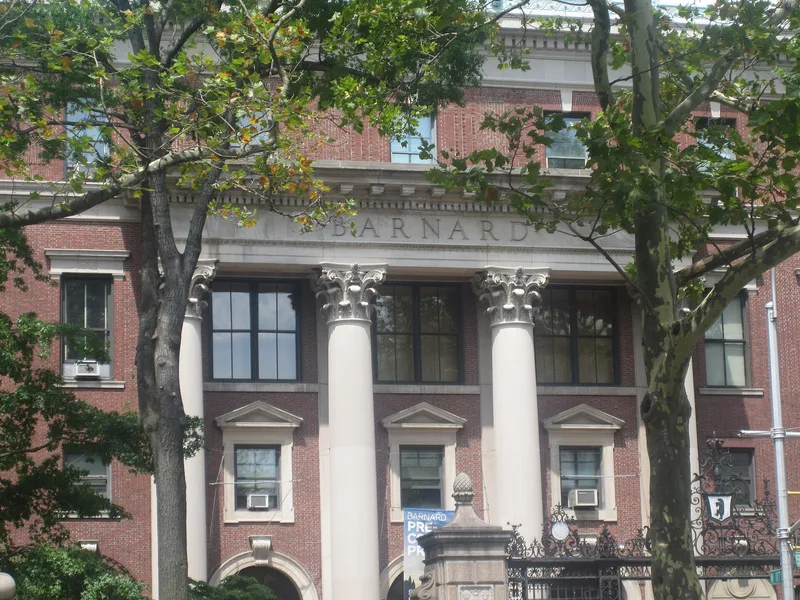
Barnard Hall, originally called Students' Hall, is a four-story building on the Barnard College campus in Morningside Heights, Manhattan. Completed in 1916, it faces Broadway and Columbia University across the street. Its red Harvard brick walls carry limestone and terra-cotta trim, and a three-story portico with four Corinthian columns marks the entrance. Inside are a gymnasium with a hanging running track, a basement swimming pool, and original terrazzo and marble floors. The building was funded by banker and philanthropist Jacob H. Schiff, who gave $500,000 to mark fifty years since his arrival in America. It was Barnard's first major expansion after the Milbank Hall complex of 1898, and it supplied a library, gymnasium, lecture hall, cafeteria and classrooms. Barnard was the first college for women in New York City. The building is also valued as the work of architect Arnold Brunner, and it is the only Schiff-funded building remaining among the educational institutions of Morningside Heights.
Significance in brief: It is argued to be significant for its role in the history of women's education, as the first major expansion of Barnard's academic facilities after Milbank Hall. It is also tied to donor Jacob H. Schiff, a leading banker and philanthropist, and it is a fine work by architect Arnold Brunner combining Italian Renaissance and Colonial features.
Machine-generated summary. This summary was generated by a language model from the official nomination document and has not been reviewed line by line by an editor. It may contain errors. Check the source document before relying on any detail. Source: nomination document (PDF) · National Archives catalog entry. NRHP reference 03001150, listed November 15, 2003. Summary generated October 2026 (model claude-sonnet-5-5, prompt v1.0-2026-10-29, confidence high).
Key facts
| Address | Barnard College, 3005 Broadway, New York |
|---|---|
| County | Manhattan |
| Listed | November 15, 2003 |
| Reference number | 03001150 |
| Resource type | Building |
| Period of significance | 1916-1921 |
| Architect / builder | Brunner, Arnold; Buchman & Fox (associate architects) |
| Architectural style | Late 19th & Early 20th Century Revivals / Italian Renaissance / Colonial Revival |
| Criteria |
|
| Areas of significance | Education, Architecture |
| Level of significance | Local |
| Status (as stated in the nomination) | Still in educational use as Barnard Hall; the form says it retains a high degree of integrity inside and out, with the main exterior change being replacement of original wood window sash with aluminum. |
| Acreage | 1 |
| Coordinates | 40.80913, -73.96399 (NPS GIS) |
What listing means for this property
National Register listing is honorary for a privately owned home: it does not by itself restrict what an owner may do with their own money, and it does not require public access. Restrictions come from local landmark or historic-district ordinances, which are separate (how they differ).
Owner-occupied houses are not eligible for the 20% federal rehabilitation tax credit, which applies to income-producing buildings, but many states offer credits for homeowners. Listing also opens the door to preservation easements and to buying a plaque. Start with what listing means for homeowners, renovating a listed house and selling one.
General information, not legal or tax advice. Rules change; confirm with your State Historic Preservation Office or a qualified adviser.
Sources and further reading
- National Park Service, National Register of Historic Places database (snapshot May 2026), reference 03001150.
- Nomination form (PDF, National Archives) — catalog entry
- Wikipedia article (used for cross-checking only; text not reproduced here)
- Wikidata Q7627931
- This listing as JSON
Last updated October 2026. Found an error? See the editorial policy for how to report it.