Schermerhorn Row Block
Also known as: New York State Maritime Museum Block

Why it's listed
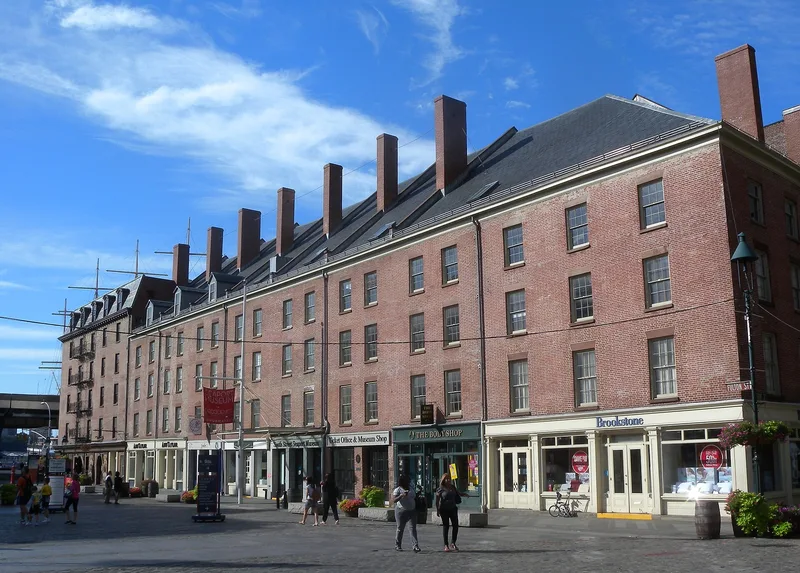
This city block at the edge of lower Manhattan's old port contains a group of brick warehouse and commercial buildings from the early 1800s. Its core is Schermerhorn Row, built in 1811 and 1812 by ship's chandler Peter Schermerhorn on landfill that had been part of the East River. He intended the row to be a leading mercantile center, and merchants were its first occupants. Later tenants included grocers, hotels, saloons, eating houses, woodworking shops and clothiers, so the buildings record the growth of the port's economy. The block also includes buildings on Front Street and Burling Slip, mostly built in the first half of the 19th century, with some parts possibly as early as 1793. Many have load-bearing masonry walls and early wooden hoists, and one retains fish-smoking kilns. Some were raised in height or given a mansard roof in later years. The block is regarded as one of the last surviving pieces of New York's sailing-age waterfront.
Significance in brief: The block holds some of the last waterfront buildings left from New York City's sailing age. Peter Schermerhorn built the row to be a major mercantile center, and the businesses that occupied it over time show the economic growth of the early port. Later alterations, such as the 1868 mansard roof, show how the buildings were updated.
Machine-generated summary. This summary was generated by a language model from the official nomination document and has not been reviewed line by line by an editor. It may contain errors. Check the source document before relying on any detail. Source: nomination document (PDF) · National Archives catalog entry. NRHP reference 71000547, listed February 18, 1971. Summary generated October 2026 (model claude-sonnet-5-5, prompt v1.0-2026-10-29, confidence medium).
Key facts
| Address | Block bounded by Front, Fulton, and South Sts., and Burling Slip, New York |
|---|---|
| County | Manhattan |
| Listed | February 18, 1971 |
| Reference number | 71000547 |
| Resource type | District |
| Period of significance | 19th Century |
| Architect / builder | Peter Schermerhorn (builder of Schermerhorn Row, 1811-1812) |
| Areas of significance | Commerce, Transportation, Architecture |
| Level of significance | State |
| Status (as stated in the nomination) | Condition is listed as good and altered. The block is state-owned, with preservation work in progress, and is slated to become the New York State Maritime Museum. |
| Acreage | 9.9 |
| Coordinates | 40.70480, -74.00608 (NPS GIS) |
What listing means for this property
This is a historic district. Buildings within its boundary are either contributing (they add to the district's significance) or non-contributing. Owners of contributing income-producing buildings can claim the 20% federal rehabilitation tax credit; homeowners should look at state credits. National Register districts impose no design review by themselves; a local historic district ordinance, if one exists, does (the difference explained).
General information, not legal or tax advice. Rules change; confirm with your State Historic Preservation Office or a qualified adviser.
Sources and further reading
- National Park Service, National Register of Historic Places database (snapshot May 2026), reference 71000547.
- Nomination form (PDF, National Archives) — catalog entry
- Wikipedia article (used for cross-checking only; text not reproduced here)
- Wikidata Q7431201
- This listing as JSON
Last updated October 2026. Found an error? See the editorial policy for how to report it.