Plaza Hotel
Also known as: Plaza Hotel and Grand Army Plaza

Why it's listed
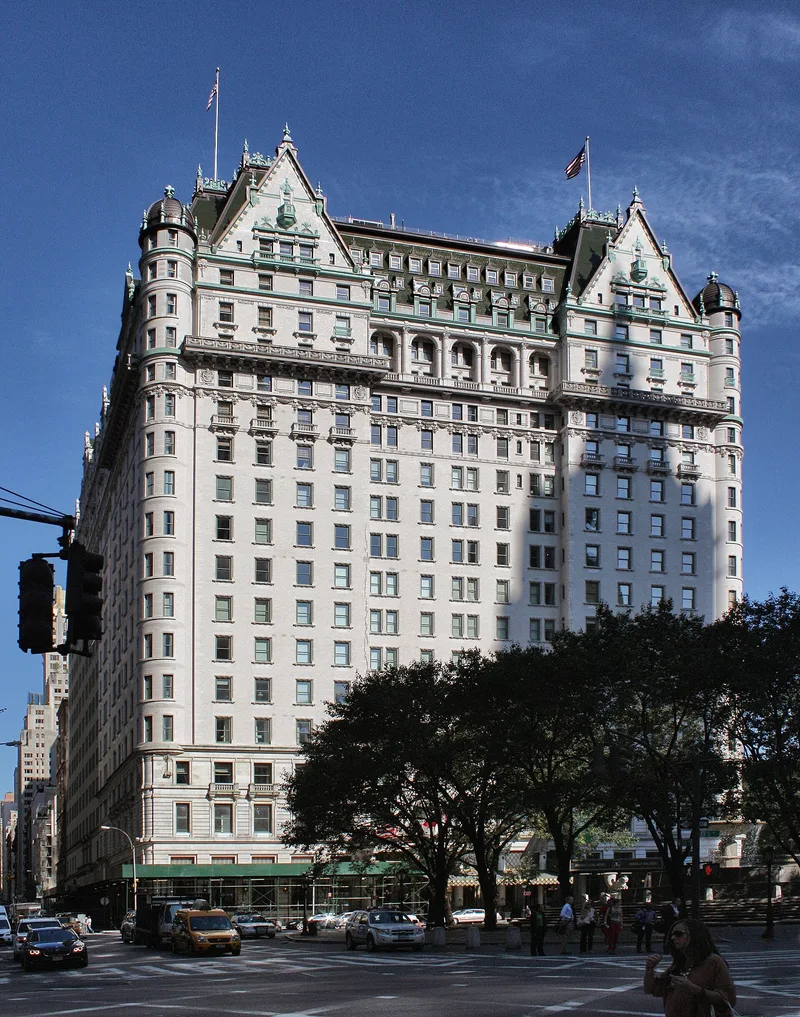
At the corner of Fifth Avenue and Central Park South stands an eighteen-story hotel of white brick and marble, built in 1905-1907 to designs by Henry J. Hardenbergh in the French Renaissance style. It replaced an earlier hotel of the same name from 1890. Its facades are organized into a base, shaft and crown, with corner turrets, gables, and a steep green mansard roof with tiers of dormers. A 1921 wing added about three hundred rooms, and public rooms such as the Palm Court, Oak Bar and Edwardian Room keep early features. Facing the hotel is Grand Army Plaza, laid out in 1913 by Thomas Hastings of Carrere & Hastings. It holds the Pulitzer Fountain, crowned by Karl Bitter's statue of Pomona, and Augustus Saint-Gaudens' statue of General Sherman. The district was listed for its architecture, its role in the city's social life, and the plaza's City Beautiful design, which forms a formal entrance to Central Park.
Significance in brief: The hotel is presented as one of the most distinguished examples of early twentieth-century American architecture and has been closely tied to the social life of New York for seventy years. Grand Army Plaza is significant as a carefully planned example of the City Beautiful movement. It contains the Pulitzer Fountain with Karl Bitter's Pomona and Augustus Saint-Gaudens' Sherman statue.
Machine-generated summary. This summary was generated by a language model from the official nomination document and has not been reviewed line by line by an editor. It may contain errors. Check the source document before relying on any detail. Source: nomination document (PDF) · National Archives catalog entry. NRHP reference 78001878, listed November 29, 1978. Summary generated October 2026 (model claude-sonnet-5-5, prompt v1.0-2026-10-29, confidence medium).
Key facts
| Address | Fifth Ave. and Fifty-ninth St., New York |
|---|---|
| County | Manhattan |
| Listed | November 29, 1978 |
| Reference number | 78001878 |
| Resource type | District |
| Period of significance | 1900- |
| Architect / builder | Henry Janeway Hardenbergh; Thomas Hastings |
| Architectural style | French Renaissance |
| Areas of significance | Community Planning and Development, Commerce, Art, Architecture |
| Level of significance | National |
| National Historic Landmark | Yes, designated June 24, 1986 |
| Status (as stated in the nomination) | Hotel exterior described as unchanged; interiors retain many original features, with repeated refurbishing and a 1921 addition. The form lists the property as occupied. |
| Acreage | 4.8 |
| Coordinates | 40.76448, -73.97446 (NPS GIS) |
What listing means for this property
This is a historic district. Buildings within its boundary are either contributing (they add to the district's significance) or non-contributing. Owners of contributing income-producing buildings can claim the 20% federal rehabilitation tax credit; homeowners should look at state credits. National Register districts impose no design review by themselves; a local historic district ordinance, if one exists, does (the difference explained).
General information, not legal or tax advice. Rules change; confirm with your State Historic Preservation Office or a qualified adviser.
Sources and further reading
- National Park Service, National Register of Historic Places database (snapshot May 2026), reference 78001878.
- Nomination form (PDF, National Archives) — catalog entry
- Wikipedia article (used for cross-checking only; text not reproduced here)
- Wikidata Q1066676
- This listing as JSON
Last updated October 2026. Found an error? See the editorial policy for how to report it.