New York Stock Exchange

Why it's listed
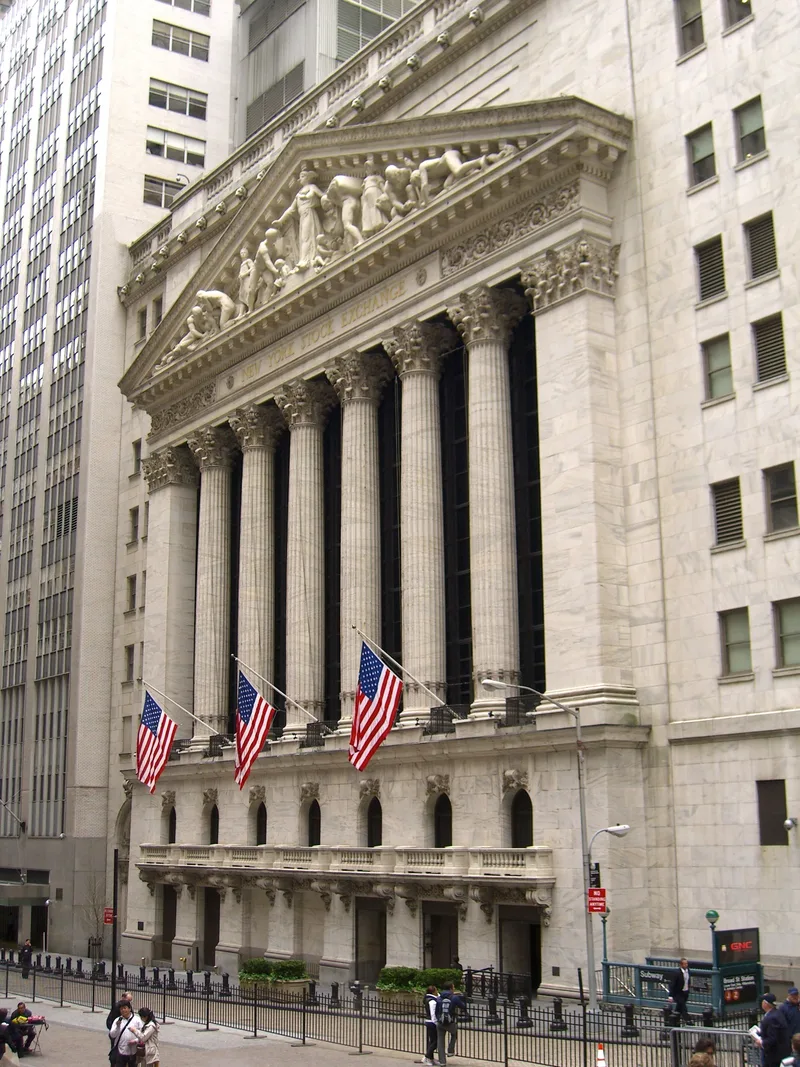
Two linked marble buildings at 18 Broad Street and 11 Wall Street in Lower Manhattan form the historic core of the New York Stock Exchange. The 10-story Broad Street building, finished in 1903, was designed by George B. Post in the Neo-Classical style. Its facade has six tall Corinthian columns and a pediment with marble figures by John Q. A. Ward, which were replaced in 1936 with copper copies after weathering. The adjoining 23-story building at 11 Wall Street, designed by Trowbridge and Livingston and completed in 1922, was made to complement the older structure, with balustrades and belt courses joining the two facades. Inside, the trading floor and the Governors' Room in the older building have changed little. The Exchange began in 1792, moved among many locations, and has occupied part of this site since 1865. The nomination presents it as the country's principal securities market and a central institution in American economic life.
Significance in brief: The nomination argues that the Exchange has played a central role in American economic development for more than 175 years and became the nation's principal securities market early in the 19th century. The Exchange has occupied part of this site since 1865 and the 18 Broad Street building since 1903. The two nominated buildings are the historic core of the complex, and the 18 Broad Street building is largely free of major structural alteration.
Machine-generated summary. This summary was generated by a language model from the official nomination document and has not been reviewed line by line by an editor. It may contain errors. Check the source document before relying on any detail. Source: nomination document (PDF) · National Archives catalog entry. NRHP reference 78001877, listed June 2, 1978. Summary generated October 2026 (model claude-sonnet-5-5, prompt v1.0-2026-10-29, confidence medium).
Key facts
| Address | 11 Wall St., New York |
|---|---|
| County | Manhattan |
| Listed | June 2, 1978 |
| Reference number | 78001877 |
| Resource type | Building |
| Period of significance | Site: 1865-present; Building: 1903-present |
| Architect / builder | 18 Broad: George B. Post (sculpture by John Q. A. Ward); 11 Wall: Trowbridge & Livingston, completed by Marc Eidlitz and Sons |
| Architectural style | Neo-Classical |
| Areas of significance | Commerce, Economics |
| Level of significance | National |
| National Historic Landmark | Yes, designated June 2, 1978 |
| Status (as stated in the nomination) | Listed as occupied, in good condition; a second trading level was planned for the 18 Broad Street trading floor. |
| Acreage | 0.9 |
| Within district | Wall Street Historic District |
| Coordinates | 40.70708, -74.01116 (NPS GIS) |
What listing means for this property
National Register listing is honorary: it recognises significance and does not restrict what a private owner may do without federal money or permits. It unlocks the 20% federal rehabilitation tax credit for income-producing buildings, state credits in many states, and Section 106 review when federal agencies are involved. See what listing means in practice.
General information, not legal or tax advice. Rules change; confirm with your State Historic Preservation Office or a qualified adviser.
Sources and further reading
- National Park Service, National Register of Historic Places database (snapshot May 2026), reference 78001877.
- Nomination form (PDF, National Archives) — catalog entry
- Wikipedia article (used for cross-checking only; text not reproduced here)
- Wikidata Q24084031
- This listing as JSON
Last updated October 2026. Found an error? See the editorial policy for how to report it.