Joralemon Street Tunnel

Why it's listed
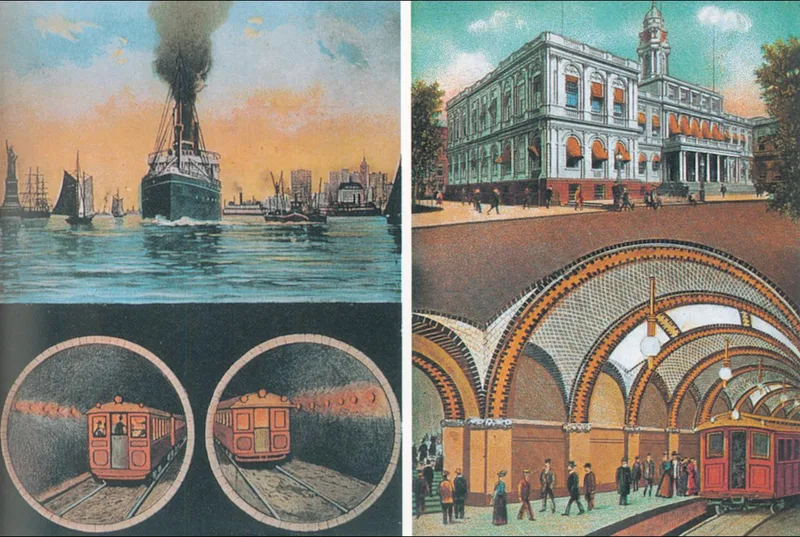
Running beneath the East River, this twin-tube subway tunnel links Bowling Green in Manhattan with Borough Hall in Brooklyn. Built between 1902 and 1908 for the original IRT system, it is about 6,544 feet long, with roughly 4,500 feet under the river. Workers used the shield method, assembling rings of bolted cast iron segments, each tube measuring 16 feet 8 inches across, and later lined the interior with concrete. The deepest point lies 94 feet below mean high water. Construction ran into grade problems, and long sections were rebuilt to give trains enough clearance. William Barclay Parsons served as engineer, John B. McDonald held the contract, and Andrew Onderdonk handled construction. When it opened on January 9, 1908, it was the first tunnel to carry paying passengers under the East River and brought subway service to Brooklyn for the first time, encouraging the borough's growth. Lexington Avenue Nos. 4 and 5 trains still use it. A rowhouse facade at 58 Joralemon Street conceals a ventilation shaft and emergency exit.
Significance in brief: It was the first tunnel to carry paying passengers under the East River and brought subway service to Brooklyn for the first time in 1908. It is an early example of shield-method tunneling and reflects innovative engineering for the original IRT system. It is significant under Criterion A (transportation, community planning and development, social history) and Criterion C (engineering).
Machine-generated summary. This summary was generated by a language model from the official nomination document and has not been reviewed line by line by an editor. It may contain errors. Check the source document before relying on any detail. Source: nomination document (PDF) · National Archives catalog entry. NRHP reference 06000015, listed February 9, 2006. Summary generated October 2026 (model claude-sonnet-5-5, prompt v1.0-2026-10-29, confidence high).
Key facts
| Address | Subteranean tunnel ext. from Bowling Green (State St.) to beneath the East River to Joralemon St. and Willow Place, New York |
|---|---|
| County | Manhattan |
| Listed | February 9, 2006 |
| Reference number | 06000015 |
| Resource type | Structure |
| Period of significance | 1902-1908 |
| Architect / builder | Parsons, William Barclay (engineer); McDonald, John B. (contractor); Onderdonk, Andrew (subcontractor) |
| Architectural style | Other: Cast iron tunnel |
| Criteria |
|
| Areas of significance | Transportation, Engineering, Community Planning and Development, Social History |
| Level of significance | Local |
| Status (as stated in the nomination) | Still in use today by Lexington Avenue subway Nos. 4 and 5 trains; interior lined with concrete, with some spalling from rusting rebar. |
| Acreage | 3.3 |
| Coordinates | 40.69806, -74.00713 (NPS GIS) |
What listing means for this property
National Register listing is honorary: it recognises significance and does not restrict what a private owner may do without federal money or permits. It unlocks the 20% federal rehabilitation tax credit for income-producing buildings, state credits in many states, and Section 106 review when federal agencies are involved. See what listing means in practice.
General information, not legal or tax advice. Rules change; confirm with your State Historic Preservation Office or a qualified adviser.
Sources and further reading
- National Park Service, National Register of Historic Places database (snapshot May 2026), reference 06000015.
- Nomination form (PDF, National Archives) — catalog entry
- Wikipedia article (used for cross-checking only; text not reproduced here)
- Wikidata Q2634761
- This listing as JSON
Last updated October 2026. Found an error? See the editorial policy for how to report it.