Central Park

Why it's listed
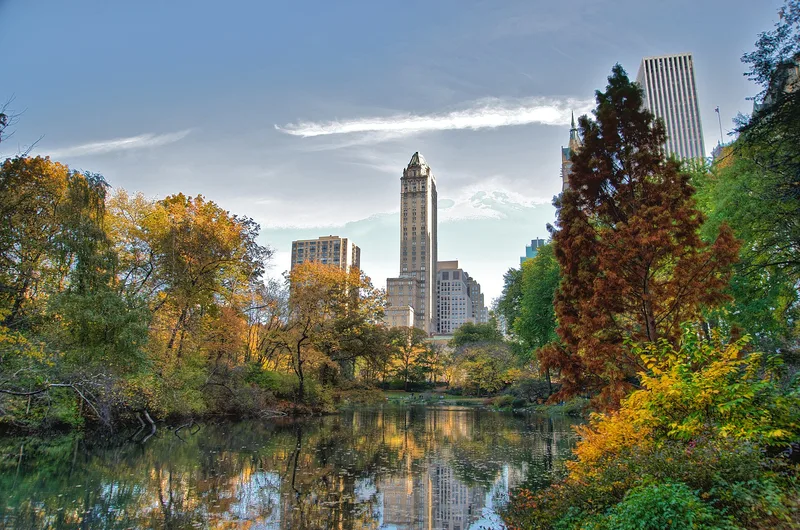
Central Park is an 840-acre public park in the middle of Manhattan, bounded by 59th Street, 110th Street, Fifth Avenue and Central Park West. Frederick Law Olmsted and Calvert Vaux won the 1858 design competition with their Greensward plan, and most of the park was complete by 1866. They turned a rocky landscape of swamps, waterways and squatters' shanties into a picturesque setting of lakes, mounds, meadows and woodland. Five separate circulation systems, including sunken transverse roads, footpaths, bridle paths and carriage drives, cross one another without conflict. About 50 bridges and arches, the formal Mall and Terrace with Bethesda Fountain, and Victorian Gothic buildings designed by Vaux and Jacob Wrey Mould add to the design. It was the first large public park in the United States built according to a plan, and it gave impetus to the national urban park movement. Later playgrounds and rinks have changed parts of the original layout.
Significance in brief: The nomination argues that Central Park holds a prominent place in the history of the American park movement because it dramatized the need for urban parks and spurred their creation. It was the first large-scale public park in the nation designed and built according to a plan. The Olmsted and Vaux design, with its naturalistic landscape and separated circulation systems, remains a notable example of their work despite later changes.
Machine-generated summary. This summary was generated by a language model from the official nomination document and has not been reviewed line by line by an editor. It may contain errors. Check the source document before relying on any detail. Source: nomination document (PDF) · National Archives catalog entry. NRHP reference 66000538, listed October 15, 1966. Summary generated October 2026 (model claude-sonnet-5-5, prompt v1.0-2026-10-29, confidence high).
Key facts
| Address | Bounded by Central Park S., 5th Ave., Central Park W., 110th St., New York |
|---|---|
| County | Manhattan |
| Listed | October 15, 1966 |
| Reference number | 66000538 |
| Resource type | District |
| Period of significance | 1857-1866 |
| Architect / builder | Frederick Law Olmsted; Calvert Vaux |
| Architectural style | Victorian Gothic (park buildings); picturesque landscape design |
| Areas of significance | Landscape Architecture |
| Level of significance | National |
| National Historic Landmark | Yes, designated May 23, 1963 |
| Status (as stated in the nomination) | Listed as in good condition and occupied; modern additions such as playgrounds, fields and rinks have altered the original plan, and restoration is hampered by lack of funding. |
| Acreage | 840 |
| Coordinates | 40.78260, -73.96548 (NPS GIS) |
What listing means for this property
This is a historic district. Buildings within its boundary are either contributing (they add to the district's significance) or non-contributing. Owners of contributing income-producing buildings can claim the 20% federal rehabilitation tax credit; homeowners should look at state credits. National Register districts impose no design review by themselves; a local historic district ordinance, if one exists, does (the difference explained).
General information, not legal or tax advice. Rules change; confirm with your State Historic Preservation Office or a qualified adviser.
Sources and further reading
- National Park Service, National Register of Historic Places database (snapshot May 2026), reference 66000538.
- Nomination form (PDF, National Archives) — catalog entry
- Wikipedia article (used for cross-checking only; text not reproduced here)
- Wikidata Q160409
- This listing as JSON
Last updated October 2026. Found an error? See the editorial policy for how to report it.