Sinclair, Harry F., House
Also known as: Augustus Van Horn Stuyvesant,Jr.,House; Ukranian Institute of

Why it's listed
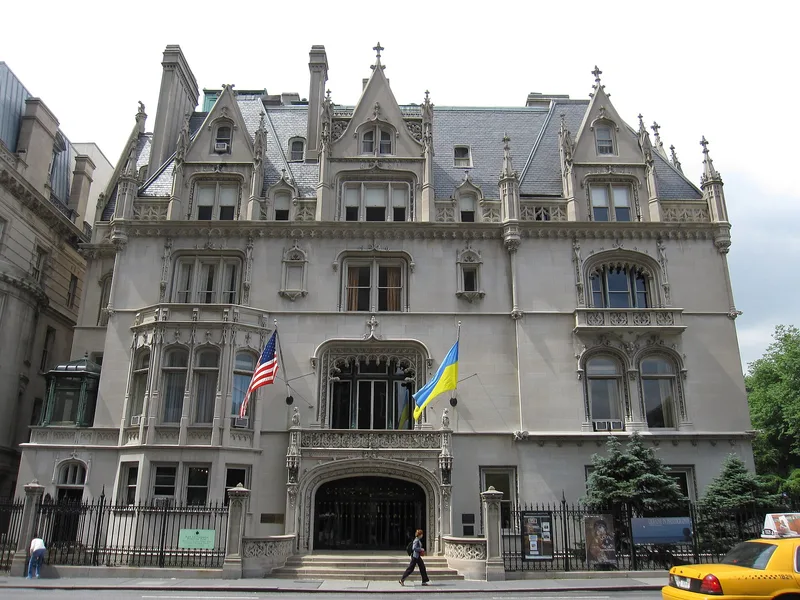
Occupying the corner of Fifth Avenue and East 79th Street in Manhattan, this 27-room mansion was designed by Charles P. H. Gilbert in 1899 for coal and tar executive Isaac D. Fletcher and built by Henry Murdock for $200,000. Limestone ashlar covers the ornate facades, and a steep slate mansard roof carries copper and terra cotta decoration. Inside are carved woodwork, decorated ceilings and marble mantels. Oil entrepreneur Harry F. Sinclair bought the house in 1918 and lived here until 1930, a period that included the Teapot Dome scandal. During those years his Sinclair Oil Corporation became the largest independent oil company in the country and funded refining research. Augustus Van Horne Stuyvesant, Jr. bought the house in 1930, and the Ukrainian Institute of America acquired it in 1955. Exterior changes since Sinclair's time are absent, and it is the residence most closely associated with him.
Significance in brief: The house is tied to oil magnate Harry F. Sinclair, who lived here from 1918 to 1930 at the height of his economic power and during the Teapot Dome scandal. Sinclair built the largest independent oil company of his day, sponsored refining research, and became a central figure in the scandal. This is the best-preserved building associated with him, since his office and his Great Neck mansion no longer survive.
Machine-generated summary. This summary was generated by a language model from the official nomination document and has not been reviewed line by line by an editor. It may contain errors. Check the source document before relying on any detail. Source: nomination document (PDF) · National Archives catalog entry. NRHP reference 78001882, listed June 2, 1978. Summary generated October 2026 (model claude-sonnet-5-5, prompt v1.0-2026-10-29, confidence high).
Key facts
| Address | 2 E. 79th St., New York |
|---|---|
| County | Manhattan |
| Listed | June 2, 1978 |
| Reference number | 78001882 |
| Resource type | Building |
| Period of significance | 1916-30 |
| Architect / builder | Charles C. P. Gilbert (architect); Henry Murdock (builder) |
| Architectural style | Eclectic French Renaissance |
| Areas of significance | Industry, Politics/Government |
| Level of significance | National |
| National Historic Landmark | Yes, designated June 2, 1978 |
| Status (as stated in the nomination) | Owned by the Ukrainian Institute of America, which uses it as a museum and cultural center. Generally in good condition, though the roof and plumbing need serious repair. |
| Acreage | 0.9 |
| Coordinates | 40.77672, -73.96354 (NPS GIS) |
What listing means for this property
National Register listing is honorary for a privately owned home: it does not by itself restrict what an owner may do with their own money, and it does not require public access. Restrictions come from local landmark or historic-district ordinances, which are separate (how they differ).
Owner-occupied houses are not eligible for the 20% federal rehabilitation tax credit, which applies to income-producing buildings, but many states offer credits for homeowners. Listing also opens the door to preservation easements and to buying a plaque. Start with what listing means for homeowners, renovating a listed house and selling one.
General information, not legal or tax advice. Rules change; confirm with your State Historic Preservation Office or a qualified adviser.
Sources and further reading
- National Park Service, National Register of Historic Places database (snapshot May 2026), reference 78001882.
- Nomination form (PDF, National Archives) — catalog entry
- Wikipedia article (used for cross-checking only; text not reproduced here)
- Wikidata Q5668753
- This listing as JSON
Last updated October 2026. Found an error? See the editorial policy for how to report it.