Italian Community Bake Oven

Why it's listed
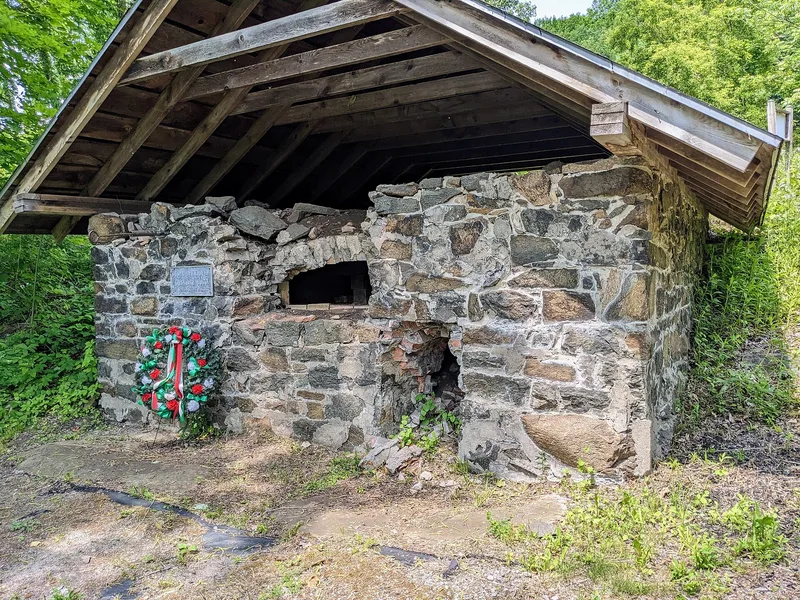
Set against a rock outcropping at the edge of a former quarry on the eastern side of Little Falls, this stone bake oven measures roughly 16 by 20 feet and stands about 6 feet high. Its walls are built of salvaged quarry stone and fieldstone, with red brick arches marking the hearth and ash cleanout. Inside, a flat firebrick dome carries the stamps of the Ostrander company of Raritan. The oven dates to about 1891, when Italian immigrant laborers were excavating the Little Falls & Dolgeville Railroad, a line backed by industrialist Alfred Dolge. A labor camp near the quarry housed the workers, and the oven produced the large quantities of bread needed to feed them. After the railroad opened in 1892 and the camp was abandoned, local families used it for baking. Now overgrown and unused, it is valued as a rare, largely intact community oven and as evidence of Italian immigrant labor in the area.
Significance in brief: The nomination argues it is a rare and largely intact example of a large, utilitarian community oven. It was built to supply bread to a camp of Italian immigrant laborers building the Little Falls & Dolgeville Railroad. After the camp closed, neighboring families used it for communal baking. It reflects a little-documented part of local history.
Machine-generated summary. This summary was generated by a language model from the official nomination document and has not been reviewed line by line by an editor. It may contain errors. Check the source document before relying on any detail. Source: nomination document (PDF) · National Archives catalog entry. NRHP reference 06001003, listed November 8, 2006. Summary generated October 2026 (model claude-sonnet-5-5, prompt v1.0-2026-10-29, confidence high).
Key facts
| Address | NY 167, Little Falls |
|---|---|
| County | Herkimer County |
| Listed | November 8, 2006 |
| Reference number | 06001003 |
| Resource type | Structure |
| Period of significance | 1891 |
| Architectural style | No style |
| Criteria |
|
| Areas of significance | Social History, Architecture |
| Level of significance | Local |
| Status (as stated in the nomination) | Abandoned and not in use, surrounded by second-growth trees and scrub; the original firebrick floor has been removed. Local efforts to preserve and interpret it are noted. |
| Acreage | 0.9 |
| Coordinates | 43.03921, -74.83344 (NPS GIS) |
What listing means for this property
National Register listing is honorary: it recognises significance and does not restrict what a private owner may do without federal money or permits. It unlocks the 20% federal rehabilitation tax credit for income-producing buildings, state credits in many states, and Section 106 review when federal agencies are involved. See what listing means in practice.
Noted as vacant in the nomination. Nomination documents can be decades old; current status may differ. If you are considering buying an empty listed property, read the due-diligence checklist.
General information, not legal or tax advice. Rules change; confirm with your State Historic Preservation Office or a qualified adviser.
Sources and further reading
- National Park Service, National Register of Historic Places database (snapshot May 2026), reference 06001003.
- Nomination form (PDF, National Archives) — catalog entry
- Wikipedia article (used for cross-checking only; text not reproduced here)
- Wikidata Q15228913
- This listing as JSON
Last updated October 2026. Found an error? See the editorial policy for how to report it.