St. Mary's Episcopal Church

Why it's listed
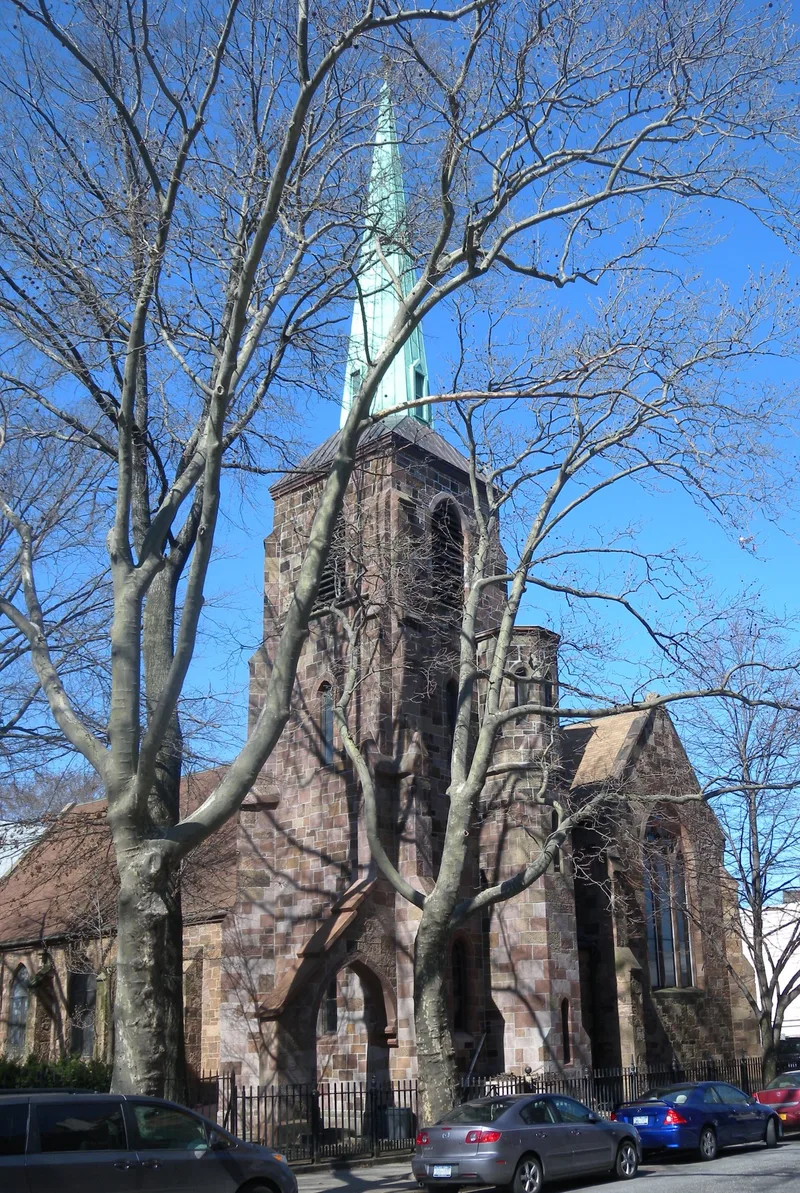
St. Mary's Episcopal Church, at Classon and Willoughby Avenues in Brooklyn's Clinton Hill, is a brownstone Gothic Revival church designed in 1858 by Richard T. Auchmuty, then junior partner to James Renwick. It opened for services in June 1859. The design draws loosely on an Early English rural parish church, with a deep chancel, a steep nave roof, a square tower with a broached spire, and a pointed-arch gateway shaped like a stepped flying buttress that guides visitors to the corner entrance porch. The nave is built of Belleville brownstone and lit by paired lancet windows. The parish began in 1835 among Navy Yard workers and was among the first to offer free pews. The site also holds the 1892 Johnson Memorial Parish House, a brick rectory with a mansard roof, and the original cast-iron fence. The church is valued as one of the best-preserved mid-nineteenth-century Gothic Revival churches in Brooklyn.
Significance in brief: The church is described as one of the most intact surviving mid-nineteenth-century Gothic Revival churches in Brooklyn. Auchmuty based the design loosely on an Early English rural parish church, following ecclesiological principles while adapting it to an urban site. A contemporary periodical called it the most beautiful church in Brooklyn.
Machine-generated summary. This summary was generated by a language model from the official nomination document and has not been reviewed line by line by an editor. It may contain errors. Check the source document before relying on any detail. Source: nomination document (PDF) · National Archives catalog entry. NRHP reference 83001701, listed July 21, 1983. Summary generated October 2026 (model claude-sonnet-5-5, prompt v1.0-2026-10-29, confidence high).
Key facts
| Address | 230 Classon Ave., New York |
|---|---|
| County | Brooklyn |
| Listed | July 21, 1983 |
| Reference number | 83001701 |
| Resource type | Building |
| Period of significance | 1858-1859 |
| Architect / builder | Richard T. Auchmuty |
| Architectural style | Gothic Revival |
| Areas of significance | Architecture |
| Level of significance | Local |
| Status (as stated in the nomination) | Occupied and in religious use; condition listed as good and altered, on its original site. The congregation is described as fairly small. |
| Acreage | 0.9 |
| Coordinates | 40.69279, -73.96128 (NPS GIS) |
What listing means for this property
Religious properties are listed for their architectural or historical significance, not their religious use. Listing is honorary and does not restrict the congregation's use of the building. The federal rehabilitation credit is generally unavailable unless part of the building is income-producing; some state programmes and preservation grants do cover religious buildings. Federal funding or permits trigger Section 106 review.
General information, not legal or tax advice. Rules change; confirm with your State Historic Preservation Office or a qualified adviser.
Sources and further reading
- National Park Service, National Register of Historic Places database (snapshot May 2026), reference 83001701.
- Nomination form (PDF, National Archives) — catalog entry
- Wikipedia article (used for cross-checking only; text not reproduced here)
- Wikidata Q7590278
- This listing as JSON
Last updated October 2026. Found an error? See the editorial policy for how to report it.