Prospect Hall

Why it's listed
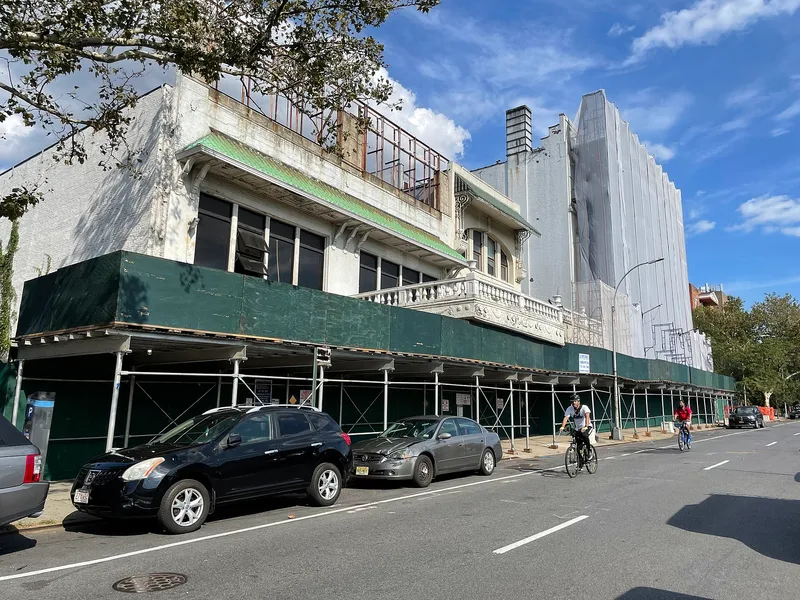
Prospect Hall is a four-story brick building at 263 Prospect Avenue in Brooklyn, built in 1901-1903 to designs by Ulrich J. Huberty. Its buff-gray brick front carries pressed-metal ornament originally painted to imitate limestone, and a large pedimented cornice. Inside are a grand cast-iron main stair, a second-floor ballroom and theatre with marble columns, boxes and an original electric dome light, a rathskeller with painted murals, an oak bar, and two basement bowling alleys with fourteen lanes. John Kolle, a German immigrant, built the hall to replace an earlier one destroyed by fire in December 1900. It offered dining, entertainment, recreation and meeting space to a largely German community, including Masonic lodges and singing societies. His son William managed it, and the family owned it until 1940, when a Polish-American organization bought it. The hall represents the large ethnic halls that helped immigrants adjust to American life.
Significance in brief: It is an important example of the large ethnic social, cultural and entertainment hall that served European immigrant neighborhoods at the turn of the 20th century. Founded by German immigrant John Kolle, it hosted German societies, Masonic lodges, theatre, dining and recreation. It is also an outstanding example of its architectural type and period, with largely intact interiors.
Machine-generated summary. This summary was generated by a language model from the official nomination document and has not been reviewed line by line by an editor. It may contain errors. Check the source document before relying on any detail. Source: nomination document (PDF) · National Archives catalog entry. NRHP reference 99000460, listed April 15, 1999. Summary generated October 2026 (model claude-sonnet-5-5, prompt v1.0-2026-10-29, confidence medium).
Key facts
| Address | 263 Prospect Ave., Brooklyn |
|---|---|
| County | Brooklyn |
| Listed | April 15, 1999 |
| Reference number | 99000460 |
| Resource type | Building |
| Period of significance | 1901-1903 |
| Architect / builder | Huberty, Ulrich J., Architect |
| Architectural style | Late 19th and 20th Century Revivals: French Renaissance |
| Criteria |
|
| Areas of significance | Social History, European, Entertainment/Recreation, Architecture |
| Level of significance | State, Local |
| Status (as stated in the nomination) | The rathskeller has been used continuously as a public restaurant and the hall's current functions include a music facility. The bowling alleys are long out of use, and some missing exterior ornament is planned for restoration. |
| Acreage | 1.5 |
| Coordinates | 40.66378, -73.98947 (NPS GIS) |
What listing means for this property
National Register listing is honorary for a privately owned home: it does not by itself restrict what an owner may do with their own money, and it does not require public access. Restrictions come from local landmark or historic-district ordinances, which are separate (how they differ).
Owner-occupied houses are not eligible for the 20% federal rehabilitation tax credit, which applies to income-producing buildings, but many states offer credits for homeowners. Listing also opens the door to preservation easements and to buying a plaque. Start with what listing means for homeowners, renovating a listed house and selling one.
General information, not legal or tax advice. Rules change; confirm with your State Historic Preservation Office or a qualified adviser.
Sources and further reading
- National Park Service, National Register of Historic Places database (snapshot May 2026), reference 99000460.
- Nomination form (PDF, National Archives) — catalog entry
- Wikipedia article (used for cross-checking only; text not reproduced here)
- Wikidata Q5594975
- This listing as JSON
Last updated October 2026. Found an error? See the editorial policy for how to report it.