Lott, Hendrick I., House

Why it's listed
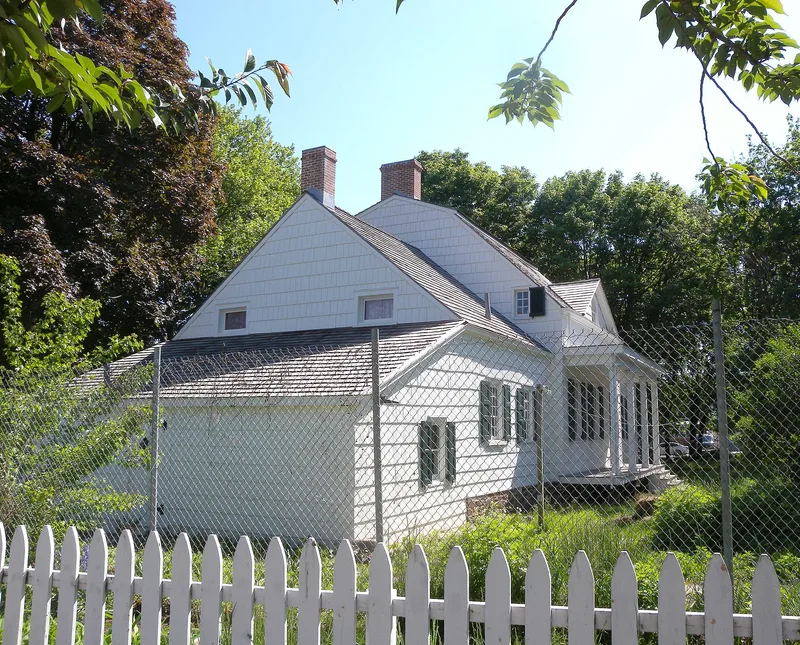
This farmhouse at 1940 East 36th Street in Brooklyn combines two building campaigns. Johannes Lott built the original house in 1720 on a farm he bought in Flatlands in 1719. In 1800 his grandson Hendrick I. Lott built a new main house in traditional Dutch Colonial form, moving the 1720 kitchen to the eastern end as a wing. The two-and-one-half-story center section has a high gambrel roof that curves over a portico with four round wooden columns, plus dormers and long cedar shingle siding. Windows and entrance moldings show Federal period influence. A veranda was added on the north side before 1860. The house is valued as one of very few Dutch Colonial farmhouses left in New York City, and as a Colonial-era residence held by one family for its entire history. Postwar attached homes now surround the three-quarter-acre lot, which a wooden picket fence encloses.
Significance in brief: It is one of the very few remaining Dutch Colonial-style farmhouses in New York City. It shows Federal-period influence in its windows, dormers and entrance moldings. It is also tied to one of Brooklyn's oldest Dutch families and stayed in the same family through its history.
Machine-generated summary. This summary was generated by a language model from the official nomination document and has not been reviewed line by line by an editor. It may contain errors. Check the source document before relying on any detail. Source: nomination document (PDF) · National Archives catalog entry. NRHP reference 83004645, listed March 3, 1994. Summary generated October 2026 (model claude-sonnet-5-5, prompt v1.0-2026-10-29, confidence high).
Key facts
| Address | 1940 E. 36th St., Brooklyn |
|---|---|
| County | Brooklyn |
| Listed | March 3, 1994 |
| Reference number | 83004645 |
| Resource type | Building |
| Period of significance | 1800-1899 |
| Architect / builder | Henrick I. Lott |
| Architectural style | Dutch Colonial with Federal period details |
| Criteria |
|
| Areas of significance | Architecture |
| Level of significance | Local |
| Status (as stated in the nomination) | Described as excellent, unaltered and carefully maintained, on its original site. Ownership later passed to a preservation association, which withdrew an earlier owner objection to listing. |
| Acreage | 0.7 |
| Coordinates | 40.61028, -73.93230 (NPS GIS) |
What listing means for this property
National Register listing is honorary for a privately owned home: it does not by itself restrict what an owner may do with their own money, and it does not require public access. Restrictions come from local landmark or historic-district ordinances, which are separate (how they differ).
Owner-occupied houses are not eligible for the 20% federal rehabilitation tax credit, which applies to income-producing buildings, but many states offer credits for homeowners. Listing also opens the door to preservation easements and to buying a plaque. Start with what listing means for homeowners, renovating a listed house and selling one.
General information, not legal or tax advice. Rules change; confirm with your State Historic Preservation Office or a qualified adviser.
Sources and further reading
- National Park Service, National Register of Historic Places database (snapshot May 2026), reference 83004645.
- Nomination form (PDF, National Archives) — catalog entry
- Wikipedia article (used for cross-checking only; text not reproduced here)
- Wikidata Q5713710
- This listing as JSON
Last updated October 2026. Found an error? See the editorial policy for how to report it.