Albany Institute of History and Art

Why it's listed
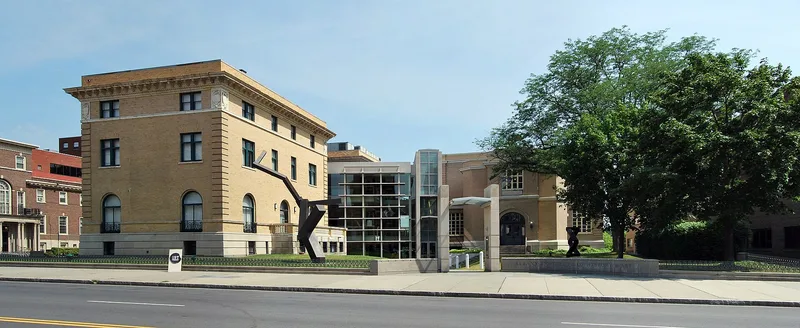
Two linked buildings at Washington Avenue and Dove Street in Albany house the Albany Institute of History and Art. The Institute building, finished in 1907 to designs by architect Albert W. Fuller, is a two-story neoclassical structure of light brick with Indiana limestone quoins and a belt course. Beside it stands the Rice House, built in 1894-95 for William Gorham Rice by Richard Morris Hunt and his son Richard H. Hunt. Faced in yellow Roman brick, it is the city's only free-standing Beaux Arts mansion, and its original stairway, mahogany mantels and library survive. The Institute acquired the house in 1966. The organization traces its origins to a 1791 agricultural and arts society whose first president was Robert R. Livingston. It is described as the second oldest museum in the country and the oldest scientific organization in New York State. Joseph Henry read his first paper on electromagnetism there in 1829. Later mergers produced the present institution.
Significance in brief: The Albany Institute, founded in 1791, is described as the second oldest museum in the United States and the oldest scientific organization in New York State. The Rice House is the city's only free-standing Beaux Arts mansion, designed by Richard Morris Hunt and his son. The Institute building was designed by Albert W. Fuller, a prominent Albany architect.
Machine-generated summary. This summary was generated by a language model from the official nomination document and has not been reviewed line by line by an editor. It may contain errors. Check the source document before relying on any detail. Source: nomination document (PDF) · National Archives catalog entry. NRHP reference 76001202, listed July 12, 1976. Summary generated October 2026 (model claude-sonnet-5-5, prompt v1.0-2026-10-29, confidence high).
Key facts
| Address | 135 Washington Ave., Albany |
|---|---|
| County | Albany County |
| Listed | July 12, 1976 |
| Reference number | 76001202 |
| Resource type | Building |
| Period of significance | 1800-1899 |
| Architect / builder | Albert W. Fuller, Richard Morris Hunt, and Richard H. Hunt |
| Architectural style | Neoclassical (Institute building); Beaux Arts (Rice House); Renaissance Revival noted in the state data sheet |
| Areas of significance | Art, Architecture |
| Level of significance | Local |
| Status (as stated in the nomination) | Occupied and in use as a museum, library and offices; the Rice House retains its original interior features and a circa 1940 addition. |
| Acreage | 1.7 |
| Within district | Washington Avenue Corridor Historic District |
| Coordinates | 42.65567, -73.76025 (NPS GIS) |
What listing means for this property
National Register listing is honorary: it recognises significance and does not restrict what a private owner may do without federal money or permits. It unlocks the 20% federal rehabilitation tax credit for income-producing buildings, state credits in many states, and Section 106 review when federal agencies are involved. See what listing means in practice.
General information, not legal or tax advice. Rules change; confirm with your State Historic Preservation Office or a qualified adviser.
Sources and further reading
- National Park Service, National Register of Historic Places database (snapshot May 2026), reference 76001202.
- Nomination form (PDF, National Archives) — catalog entry
- Wikipedia article (used for cross-checking only; text not reproduced here)
- Wikidata Q4709330
- This listing as JSON
Last updated October 2026. Found an error? See the editorial policy for how to report it.