Textile District

Why it's listed
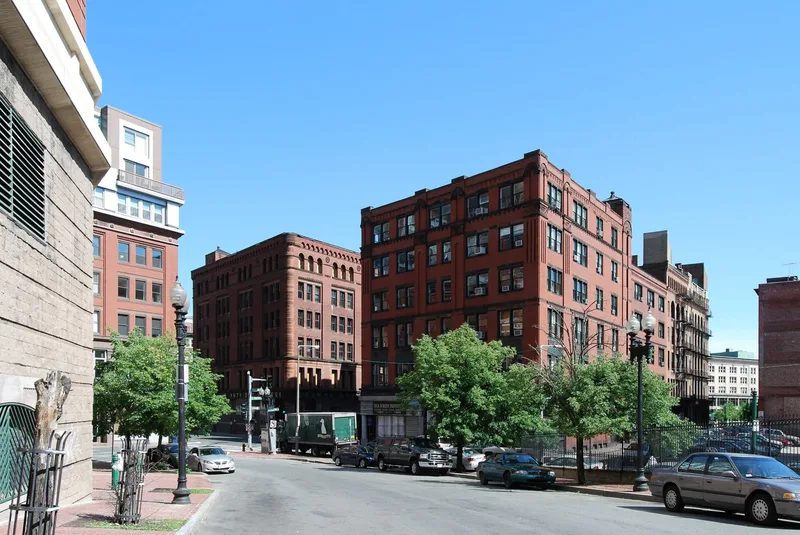
Located in the southern part of Boston's Central Business District, this roughly three-acre district takes in buildings along Chauncy, Essex, Edinboro and Kingston Streets. Most are five to eight stories, built between 1888 and 1922 of red or yellow brick with trim of brownstone, terracotta, cast stone and granite. Classical Revival detailing dominates, with Romanesque Revival and Renaissance Revival examples among them. The area grew into the center of Boston's dry goods trade, and textile businesses still occupied several storefronts when the district was documented. Its streets lie partly over land that was once waterfront, where Colonial wharves along Essex Street were buried when South Cove was filled between 1804 and 1833. The buildings are works of well-known Boston architects, including William Ralph Emerson, Stephen Codman and Fehmer & Page. The district was listed for its commercial history and for the quality and consistency of its architecture. Original storefronts survive on most buildings, while some have been modernized at street level.
Significance in brief: The district is argued to be significant for its link to Boston's dry goods industry in the late 19th and early 20th centuries and for its rare concentration of well-preserved, architecturally distinguished buildings. Most are in Classical Revival style, with Romanesque and Renaissance Revival examples. The buildings are works of leading Boston architects of the period.
Machine-generated summary. This summary was generated by a language model from the official nomination document and has not been reviewed line by line by an editor. It may contain errors. Check the source document before relying on any detail. Source: nomination document (PDF) · National Archives catalog entry. NRHP reference 90001757, listed November 29, 1990. Summary generated October 2026 (model claude-sonnet-5-5, prompt v1.0-2026-10-29, confidence high).
Key facts
| Address | Roughly, Essex St. from Phillips Sq. to Columbia St. and Chauncy St. from Phillips Sq. to Rowe Pl., Boston |
|---|---|
| County | Suffolk County |
| Listed | November 29, 1990 |
| Reference number | 90001757 |
| Resource type | District |
| Period of significance | 1888-1922 |
| Architect / builder | Multiple architects including Benjamin Fox, Winslow, Wetherell & Bigelow, Blackall, Clapp & Whittemore, Allen & Collens, Stephen Codman, George W. Pope, Frederick Pope, Kendall, Taylor & Stevens, William Ralph Emerson, Theodore Minot Clark, J. Merrill Brown, Fehmer & Page |
| Architectural style | Late 19th Century Revivals/Classical Revival; Late Victorian/Romanesque Revival; Renaissance Revival; Gothic Revival; Modern Movement/International Style |
| Criteria |
|
| Areas of significance | Community Planning and Development, Architecture |
| Level of significance | Local |
| Status (as stated in the nomination) | Buildings largely retain integrity; upper floors of several restored buildings are used as offices and storefronts continue commercial use. The Edinboro Building was destroyed by fire in October 1989, and the Pelham Building was damaged by fire but still stands. |
| Acreage | 2.8 |
| Coordinates | 42.35254, -71.05976 (NPS GIS) |
What listing means for this property
This is a historic district. Buildings within its boundary are either contributing (they add to the district's significance) or non-contributing. Owners of contributing income-producing buildings can claim the 20% federal rehabilitation tax credit; homeowners should look at state credits. National Register districts impose no design review by themselves; a local historic district ordinance, if one exists, does (the difference explained).
General information, not legal or tax advice. Rules change; confirm with your State Historic Preservation Office or a qualified adviser.
Sources and further reading
- National Park Service, National Register of Historic Places database (snapshot May 2026), reference 90001757.
- Nomination form (PDF, National Archives) — catalog entry
- Wikipedia article (used for cross-checking only; text not reproduced here)
- Wikidata Q7708455
- This listing as JSON
Last updated October 2026. Found an error? See the editorial policy for how to report it.