Liberty Tree District

Why it's listed
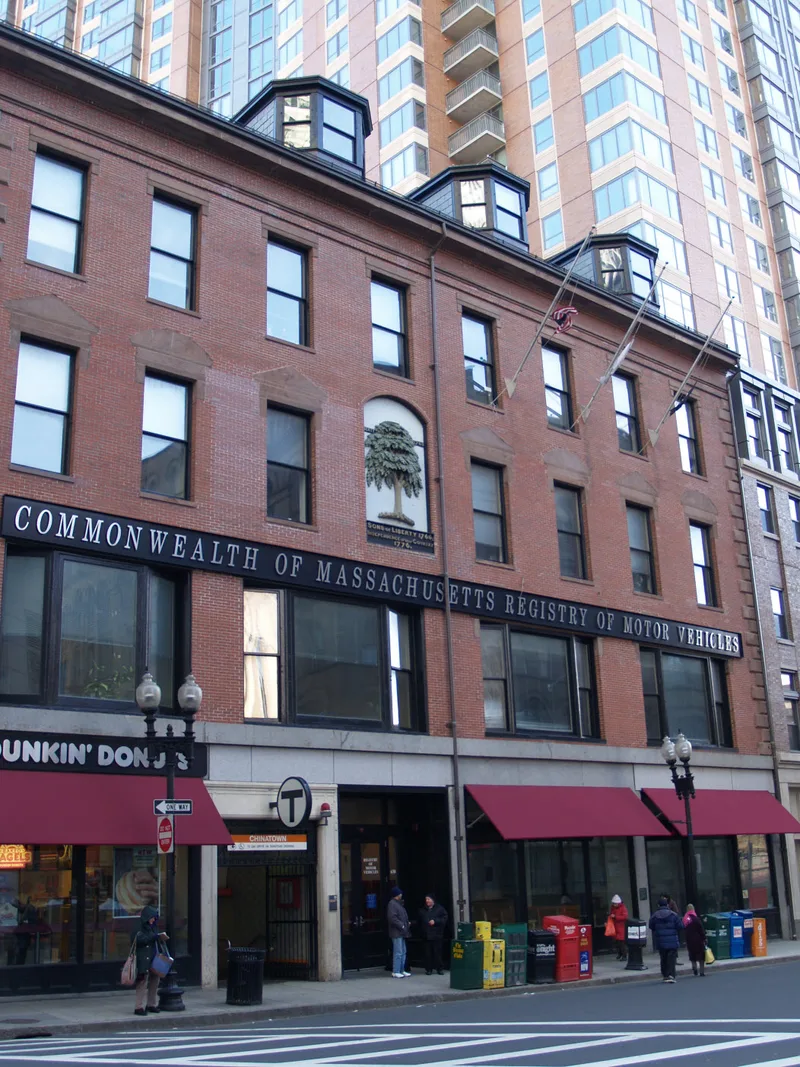
Six commercial buildings gather around the corner of Washington and Essex Streets in Boston, on ground once known as Hanover Square. This corner held the Liberty Tree Tavern and the great elm called the Liberty Tree, where the Sons of Liberty met after forming in 1765 to protest the Stamp Act. A carved relief plaque on the 1850 Liberty Tree Block, a brick Greek Revival and Italianate building, commemorates the tree. Nearby buildings show how the area developed as a commercial and travel district in the later 19th century. They include the Essex Hotel of about 1881, a polychrome High Victorian Gothic mercantile building of 1875, and a Federal Revival hotel facade at 640-644 Washington Street that grew from an 1824 hotel named for Lafayette. One building of about 1871 at 11-13 Essex Street has a wooden facade carved to imitate cast iron, and is the only one of its kind in the city's central business district.
Significance in brief: The district marks the site of the Liberty Tree and Liberty Tree Tavern, a gathering place for the Sons of Liberty and a symbol of pre-Revolutionary resistance to British rule. It is also a small ensemble of mid-to-late 19th century commercial buildings, many of individual distinction, including the only wooden-fronted commercial building in the Central Business District.
Machine-generated summary. This summary was generated by a language model from the official nomination document and has not been reviewed line by line by an editor. It may contain errors. Check the source document before relying on any detail. Source: nomination document (PDF) · National Archives catalog entry. NRHP reference 80000460, listed December 9, 1980. Summary generated October 2026 (model claude-sonnet-5-5, prompt v1.0-2026-10-29, confidence medium).
Key facts
| Address | Roughly bounded by Harrison Ave., Washington, Essex and Beach Sts., Boston |
|---|---|
| County | Suffolk County |
| Listed | December 9, 1980 |
| Reference number | 80000460 |
| Resource type | District |
| Period of significance | 1850-1900 |
| Architectural style | Greek Revival/Italianate, High Victorian Gothic, Federal Revival |
| Areas of significance | Architecture, Performing Arts |
| Level of significance | National, State, Local |
| Status (as stated in the nomination) | Uniform in private ownership and commercial use; condition described as fair to poor. |
| Acreage | 0.6 |
| Coordinates | 42.35213, -71.06254 (NPS GIS) |
What listing means for this property
This is a historic district. Buildings within its boundary are either contributing (they add to the district's significance) or non-contributing. Owners of contributing income-producing buildings can claim the 20% federal rehabilitation tax credit; homeowners should look at state credits. National Register districts impose no design review by themselves; a local historic district ordinance, if one exists, does (the difference explained).
General information, not legal or tax advice. Rules change; confirm with your State Historic Preservation Office or a qualified adviser.
Sources and further reading
- National Park Service, National Register of Historic Places database (snapshot May 2026), reference 80000460.
- Nomination form (PDF, National Archives) — catalog entry
- Wikipedia article (used for cross-checking only; text not reproduced here)
- Wikidata Q6542153
- This listing as JSON
Last updated October 2026. Found an error? See the editorial policy for how to report it.