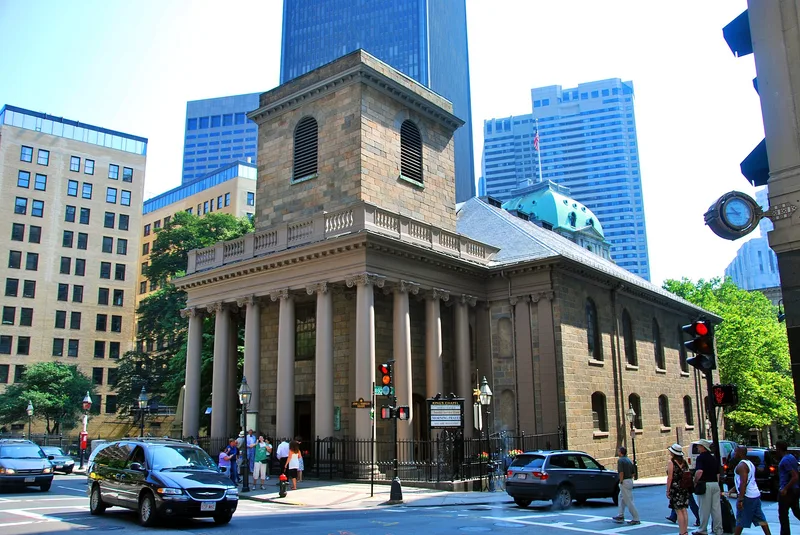
King's Chapel

Why it's listed
King's Chapel Burying Ground is a small plot on Tremont Street in Boston, founded in 1630 and enclosed by King's Chapel, Old City Hall and a commercial building. Early Puritan settler Isaac Johnson asked to be buried in his garden, and other colonists soon sought burial nearby. It served as the city's only cemetery for nearly thirty years. Interments include Governor John Winthrop, the minister John Cotton, William Dawes Jr., who rode with Paul Revere, Robert Keayne, founder of the Ancient and Honorable Artillery Company, and Mary Chilton. With nearly 1800 markers, the ground holds an almost unbroken series of stones from 1658, tracing the carver's craft from winged death's heads to neoclassical urns and willows. Nineteenth-century landscaping set the stones in rows, and an iron fence was added in 1854. Together with Old City Hall Plaza, it forms part of the chain of green spaces that begins at Boston Common.
Significance in brief: The nomination cites its early establishment as Boston's only cemetery for nearly thirty years, and its burials of persons important to the city and nation. It also cites its collection of 17th and 18th century funerary sculpture, and its role as part of Boston's chain of urban green open spaces.
Machine-generated summary. This summary was generated by a language model from the official nomination document and has not been reviewed line by line by an editor. It may contain errors. Check the source document before relying on any detail. Source: nomination document (PDF) · National Archives catalog entry. NRHP reference 74002045, listed May 2, 1974. Summary generated October 2026 (model claude-sonnet-5-5, prompt v1.0-2026-10-29, confidence medium).
Key facts
| Address | Tremont and School Sts., Boston |
|---|---|
| County | Suffolk County |
| Listed | May 2, 1974 |
| Reference number | 74002045 |
| Resource type | Building |
| Period of significance | 17th Century, 18th Century, 19th Century (specific date 1630) |
| Architect / builder | Iron fence erected in 1854 by Smith, Lovett & Co. |
| Areas of significance | Architecture |
| Level of significance | National |
| National Historic Landmark | Yes, designated October 9, 1960 |
| Status (as stated in the nomination) | Listed as in good condition, altered, on its original site; occupied and used as a cemetery, with burials officially closed by 1896 and a few tomb interments as late as the 1960s. |
| Acreage | 0.1 |
| Coordinates | 42.35803, -71.06001 (NPS GIS) |
What listing means for this property
Religious properties are listed for their architectural or historical significance, not their religious use. Listing is honorary and does not restrict the congregation's use of the building. The federal rehabilitation credit is generally unavailable unless part of the building is income-producing; some state programmes and preservation grants do cover religious buildings. Federal funding or permits trigger Section 106 review.
General information, not legal or tax advice. Rules change; confirm with your State Historic Preservation Office or a qualified adviser.
Sources and further reading
- National Park Service, National Register of Historic Places database (snapshot May 2026), reference 74002045.
- Nomination form (PDF, National Archives) — catalog entry
- Wikipedia article (used for cross-checking only; text not reproduced here)
- Wikidata Q1139921
- This listing as JSON
Last updated October 2026. Found an error? See the editorial policy for how to report it.