Moody Street Historic District

Why it's listed
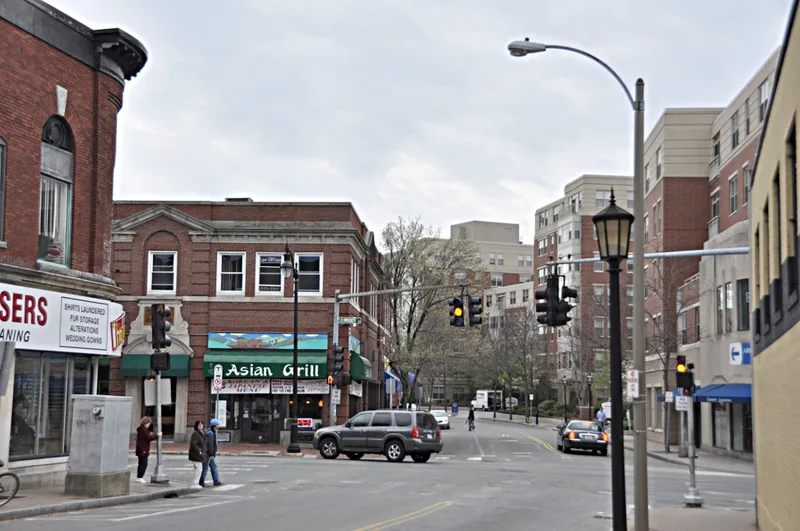
Moody Street in Waltham's South Side holds a compact group of eight commercial blocks built between 1887 and about 1950. Seven contribute to the district and one, a c1950 building, does not. Growth along the street followed the 1847 Moody Street bridge over the Charles River and the 1854 founding of the Waltham Watch Company, whose workers became the area's shoppers. Between the mid-1880s and World War II, three- and four-story masonry blocks replaced earlier wood-frame shops and houses. Examples include the Romanesque Revival Lincoln Building and Ancient Order of United Workers Building (both 1887), a Georgian Revival block of 1900, the 1929 Hall Building, the Grover Cronin department store with its 1938 Art Deco facade, and the 1948-49 Woolworth building. The blocks housed department stores, chain stores and fraternal groups. Storefronts have been replaced with aluminum fronts and signs, yet the upper stories largely survive. The district was drawn around the only contiguous intact group of significant buildings.
Significance in brief: The district is argued to be a local and regional retail core that developed between the 1880s and World War II. Its seven largely intact multi-story masonry blocks, in Romanesque Revival, Georgian Revival and Art Deco styles, replaced earlier wood-frame shops and houses and reflect the city's prosperity.
Machine-generated summary. This summary was generated by a language model from the official nomination document and has not been reviewed line by line by an editor. It may contain errors. Check the source document before relying on any detail. Source: nomination document (PDF) · National Archives catalog entry. NRHP reference 89001502, listed March 9, 1990. Summary generated October 2026 (model claude-sonnet-5-5, prompt v1.0-2026-10-29, confidence medium).
Key facts
| Address | Moody and Crescent Sts., Waltham |
|---|---|
| County | Middlesex County |
| Listed | March 9, 1990 |
| Reference number | 89001502 |
| Resource type | District |
| Period of significance | 1879-c1940 (stated on the form; a reviewer notes it conflicts with the 1948-49 Woolworth building) |
| Architectural style | Romanesque Revival, Georgian Revival and Art Deco |
| Criteria |
|
| Areas of significance | Community Planning and Development, Commerce, Architecture |
| Level of significance | Local |
| Status (as stated in the nomination) | Condition rated fair-good; current use commercial. Storefronts have been altered, but the upper floors of the major blocks remain largely intact. |
| Acreage | 5.5 |
| Coordinates | 42.37196, -71.23679 (NPS GIS) |
What listing means for this property
This is a historic district. Buildings within its boundary are either contributing (they add to the district's significance) or non-contributing. Owners of contributing income-producing buildings can claim the 20% federal rehabilitation tax credit; homeowners should look at state credits. National Register districts impose no design review by themselves; a local historic district ordinance, if one exists, does (the difference explained).
General information, not legal or tax advice. Rules change; confirm with your State Historic Preservation Office or a qualified adviser.
Sources and further reading
- National Park Service, National Register of Historic Places database (snapshot May 2026), reference 89001502.
- Nomination form (PDF, National Archives) — catalog entry
- Wikipedia article (used for cross-checking only; text not reproduced here)
- Wikidata Q6907240
- This listing as JSON
Last updated October 2026. Found an error? See the editorial policy for how to report it.