Cuming, Dr. John, House

Why it's listed
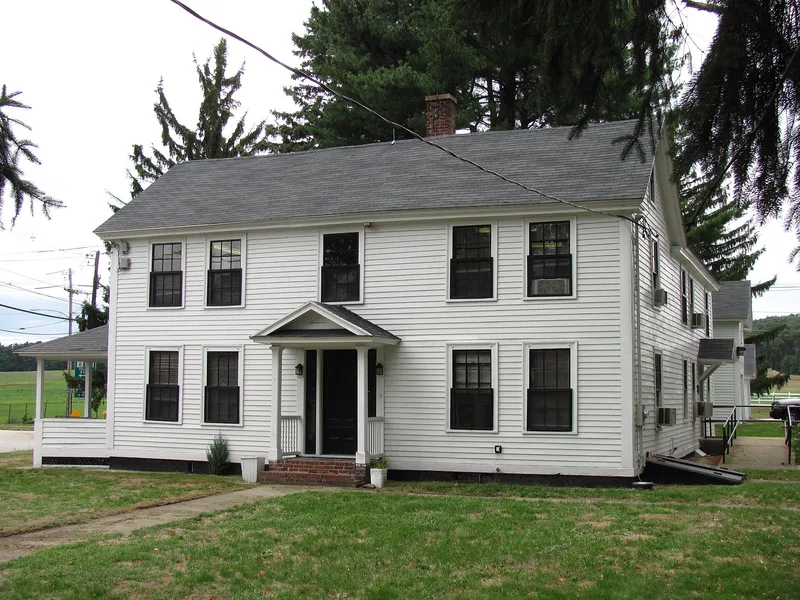
Built about 1754 on a one and one-quarter acre lot near Route 2 west of Concord, this simple farmhouse is a two-and-one-half-story wood-frame dwelling with white clapboard siding, a hipped roof and a symmetrical five-bay facade. A pedimented portico with square posts shelters the front door, which has full-length sidelights. A nineteenth-century two-story ell extends from the rear, and two small outbuildings of the same century stand behind. Tall evergreens shield the house from traffic. The property is significant as the home of Dr. John Cuming, born in Concord in 1728 and educated in part at Edinburgh. He served as a Lieutenant Colonel in the French and Indian War, treated both British and American soldiers wounded on April 19, 1775, and held town and state offices. He also helped establish Cummington, which bears his name. His 1788 bequest to Harvard was used to help found Harvard Medical School. He lived in the house from 1754 until his death.
Significance in brief: It was the home of Dr. John Cuming, a prominent eighteenth-century Concord physician, philanthropist, political figure and military officer. He treated British and American wounded on April 19, 1775, and helped found the town of Cummington. His 1788 bequest to Harvard helped establish Harvard Medical School.
Machine-generated summary. This summary was generated by a language model from the official nomination document and has not been reviewed line by line by an editor. It may contain errors. Check the source document before relying on any detail. Source: nomination document (PDF) · National Archives catalog entry. NRHP reference 77000175, listed November 11, 1977. Summary generated October 2026 (model claude-sonnet-5-5, prompt v1.0-2026-10-29, confidence medium).
Key facts
| Address | W of Concord at Barretts Mill Rd. and Reformatory Circle, Concord |
|---|---|
| County | Middlesex County |
| Listed | November 11, 1977 |
| Reference number | 77000175 |
| Resource type | Building |
| Period of significance | c. 1754 |
| Architectural style | Colonial elements (simple eighteenth-century farmhouse) |
| Areas of significance | Military, Health/Medicine, Social History |
| Level of significance | Local |
| Status (as stated in the nomination) | Owned by the Massachusetts Department of Corrections, across Route 2 from the Concord Reformatory complex; marked occupied and used as a private residence. |
| Acreage | 1.3 |
| Coordinates | 42.46729, -71.39619 (NPS GIS) |
What listing means for this property
National Register listing is honorary for a privately owned home: it does not by itself restrict what an owner may do with their own money, and it does not require public access. Restrictions come from local landmark or historic-district ordinances, which are separate (how they differ).
Owner-occupied houses are not eligible for the 20% federal rehabilitation tax credit, which applies to income-producing buildings, but many states offer credits for homeowners. Listing also opens the door to preservation easements and to buying a plaque. Start with what listing means for homeowners, renovating a listed house and selling one.
General information, not legal or tax advice. Rules change; confirm with your State Historic Preservation Office or a qualified adviser.
Sources and further reading
- National Park Service, National Register of Historic Places database (snapshot May 2026), reference 77000175.
- Nomination form (PDF, National Archives) — catalog entry
- Wikipedia article (used for cross-checking only; text not reproduced here)
- Wikidata Q5304193
- This listing as JSON
Last updated October 2026. Found an error? See the editorial policy for how to report it.