Vamp Building
Also known as: Lynn Realty Building #4

Why it's listed
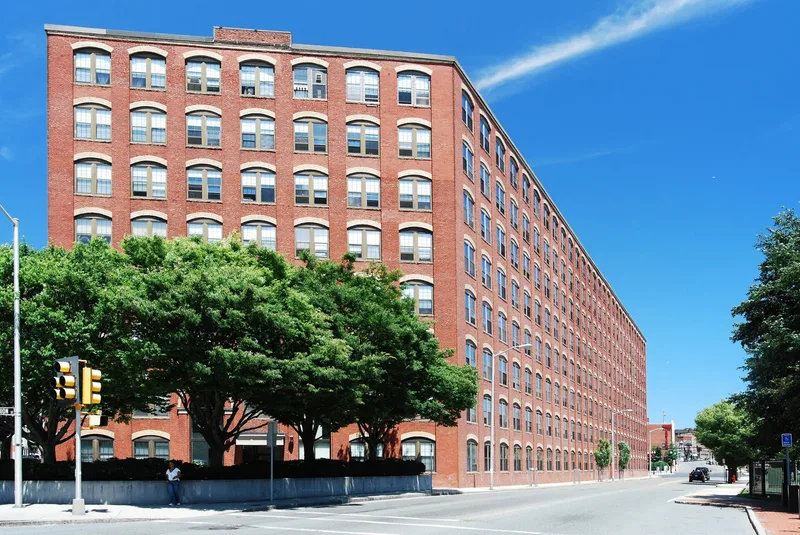
Rising eight stories at the corner of Broad and Union Streets in Lynn, the Vamp Building is a former shoe factory built in 1903, with a major addition in 1907. Henry W. Rogers is named as the architect or builder. The building was erected by the Lynn Realty Company, which built large factories during the city's last great period of shoe industry growth, and it was described as the largest shoe factory in the world. Its triangular plan wraps around a courtyard, and its red brick walls are divided by full-height pilasters into paired window bays under segmental arches. Contemporaries called its design the simplest style of mill construction, a sharp contrast to the more ornamented factories of the 1890s. It survived the fall 1981 fire that destroyed much of the surrounding factory district, and a certified rehabilitation has converted it to apartments. It was listed for its industrial history and architecture.
Significance in brief: The nomination argues it was the largest shoe factory built by the Lynn Realty Company and was believed locally to be the largest in the world. It is one of a handful of surviving downtown buildings representing Lynn's major industry. It also shows the plain mill construction used in the rebuilding after the 1889 fire, and it retains integrity of location, design, materials and workmanship.
Machine-generated summary. This summary was generated by a language model from the official nomination document and has not been reviewed line by line by an editor. It may contain errors. Check the source document before relying on any detail. Source: nomination document (PDF) · National Archives catalog entry. NRHP reference 83000587, listed March 31, 1983. Summary generated October 2026 (model claude-sonnet-5-5, prompt v1.0-2026-10-29, confidence high).
Key facts
| Address | 3-15 Liberty Square, Lynn |
|---|---|
| County | Essex County |
| Listed | March 31, 1983 |
| Reference number | 83000587 |
| Resource type | Building |
| Period of significance | 1900- |
| Architect / builder | Henry W. Rogers |
| Architectural style | Simple mill construction, described as utilitarian, with red brick and buff brick trim |
| Criteria |
|
| Areas of significance | Industry, Architecture |
| Level of significance | State, Local |
| Status (as stated in the nomination) | Converted to apartments through a certified rehabilitation after damage in the fall 1981 fire. The form lists it as occupied and in excellent condition. |
| Acreage | 1.1 |
| Coordinates | 42.46258, -70.94673 (NPS GIS) |
What listing means for this property
For an income-producing building, listing (individually or as a contributing building in a district) is the gateway to the 20% federal rehabilitation tax credit on qualified rehabilitation costs, often stackable with state credits. Work claiming the credit must follow the Secretary of the Interior's Standards and be approved in advance.
Listing does not restrict a private owner acting without federal money or permits; where federal funding or licensing is involved, Section 106 review applies.
General information, not legal or tax advice. Rules change; confirm with your State Historic Preservation Office or a qualified adviser.
Sources and further reading
- National Park Service, National Register of Historic Places database (snapshot May 2026), reference 83000587.
- Nomination form (PDF, National Archives) — catalog entry
- Wikipedia article (used for cross-checking only; text not reproduced here)
- Wikidata Q7912941
- This listing as JSON
Last updated October 2026. Found an error? See the editorial policy for how to report it.