Munroe Street Historic District

Why it's listed
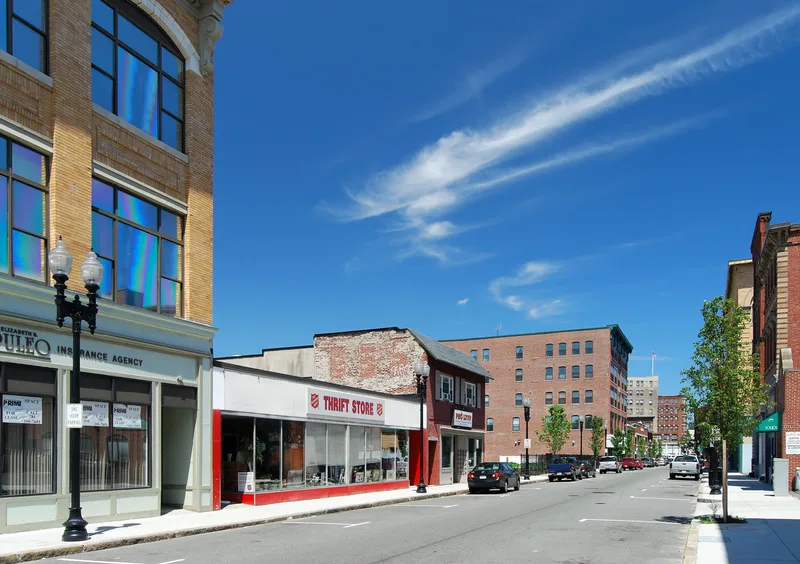
Munroe Street in downtown Lynn, Massachusetts, forms a compact commercial district of about 2.2 acres, with 18 contributing resources including brick and wood buildings from the mid-19th to mid-20th century. The street grew after the Eastern Railroad arrived in 1838 and became the center of Lynn's shoe industry by the 1850s. Five post-Civil War shoe factory lofts survive here, notable as the only ones in downtown Lynn to escape the Great Lynn Fire of 1889. Among them is the Johnson-Filene Building, where William Filene ran a one-price clothing store from 1878 to 1880, a forerunner of Filene's Department Store in Boston. Later business blocks show Panel Brick, Classical Revival, Tudor and Moderne designs, and an original granite sidewalk from about 1879 remains. Urban renewal removed some older buildings, yet the street keeps its historic retail character and much of its original streetscape.
Significance in brief: The district contains the oldest surviving shoe factory lofts and retail blocks in downtown Lynn, several of which escaped the Great Lynn Fire of 1889. Munroe Street became the center of Lynn's shoe industry by the 1850s, aided by the 1838 Eastern Railroad and the tannery brook. The buildings show retail and industrial growth through several periods and a range of architectural styles.
Machine-generated summary. This summary was generated by a language model from the official nomination document and has not been reviewed line by line by an editor. It may contain errors. Check the source document before relying on any detail. Source: nomination document (PDF) · National Archives catalog entry. NRHP reference 96000952, listed December 2, 1996. Summary generated October 2026 (model claude-sonnet-5-5, prompt v1.0-2026-10-29, confidence medium).
Key facts
| Address | Bounded by Market, Oxford, Washington Sts. and MBTA Commuter Rail, Lynn |
|---|---|
| County | Essex County |
| Listed | December 2, 1996 |
| Reference number | 96000952 |
| Resource type | District |
| Architect / builder | Holman Wheeler; John Ashton and J.S. Huntress; Somes and Parsons; Sanborn and Weed; Knut Swanson; Thomas James; Home and Manning; George Cornet |
| Architectural style | Late Victorian (Italianate, Renaissance); Late 19th-20th Century Revivals (Beaux Arts, Classical, Tudor); Commercial Style, Chicago; Art Deco-Moderne |
| Areas of significance | Architecture, Commerce, Industry |
| Level of significance | Local |
| Status (as stated in the nomination) | Remains an active retail area, though some original buildings were lost to urban renewal and business decline after 1946. |
| Acreage | 2.2 |
| Coordinates | 42.46302, -70.94748 (NPS GIS) |
What listing means for this property
This is a historic district. Buildings within its boundary are either contributing (they add to the district's significance) or non-contributing. Owners of contributing income-producing buildings can claim the 20% federal rehabilitation tax credit; homeowners should look at state credits. National Register districts impose no design review by themselves; a local historic district ordinance, if one exists, does (the difference explained).
General information, not legal or tax advice. Rules change; confirm with your State Historic Preservation Office or a qualified adviser.
Sources and further reading
- National Park Service, National Register of Historic Places database (snapshot May 2026), reference 96000952.
- Nomination form (PDF, National Archives) — catalog entry
- Wikipedia article (used for cross-checking only; text not reproduced here)
- Wikidata Q6936846
- This listing as JSON
Last updated October 2026. Found an error? See the editorial policy for how to report it.