Central Square Historic District
Also known as: See Also:Mowers' Block

Why it's listed
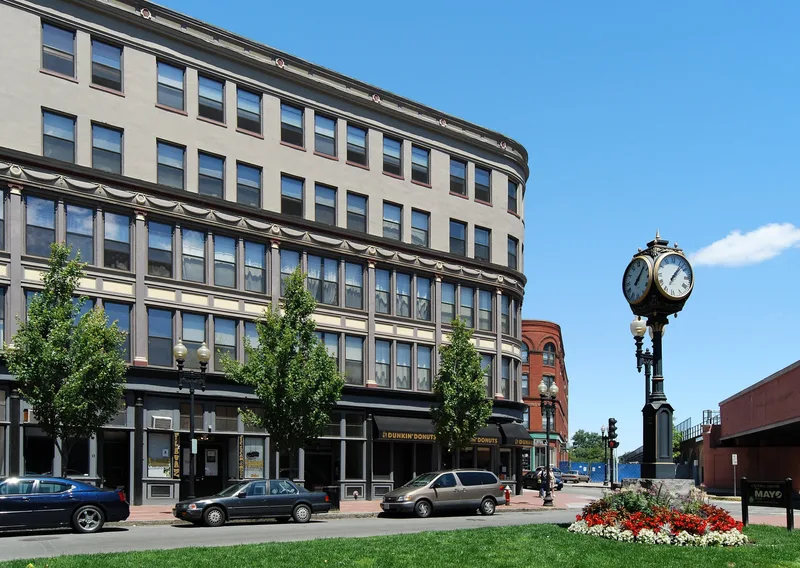
Central Square Historic District is the commercial heart of Lynn, Massachusetts, a manufacturing city about ten miles north of Boston. Covering roughly one acre, it holds 15 mostly masonry buildings of three to eight stories along Central Square and Munroe, Union and Willow Streets. Nearly all rose after the Fire of 1889 destroyed much of the downtown, when new codes required masonry construction. The area had been the city's commercial center since the railroad arrived in the 1830s and was tied to Lynn's shoe and leather industries. Buildings such as the Woodbury Building, Keith Building, Pevear Building and Dagyr Building show Romanesque Revival design, while the 1914 Security Trust Company and 1916 Lynn Manufacturers' Bank reflect Classical Revival style. Local architects, notably Henry W. Rogers, Penn Varney and the firm of Wheeler and Northend, designed most of the earlier buildings. Alterations have been mostly limited to storefronts and upper-floor remodeling, so the district keeps much of its historic character.
Significance in brief: The district is argued to be significant for its ties to Lynn's commercial development during peak industrial growth (ca. 1890-1925) and for its well-preserved late Victorian buildings erected after the Fire of 1889. Many were designed by leading local architects. It is evaluated at the local level under Criteria A and C.
Machine-generated summary. This summary was generated by a language model from the official nomination document and has not been reviewed line by line by an editor. It may contain errors. Check the source document before relying on any detail. Source: nomination document (PDF) · National Archives catalog entry. NRHP reference 85003335, listed December 10, 1985. Summary generated October 2026 (model claude-sonnet-5-5, prompt v1.0-2026-10-29, confidence high).
Key facts
| Address | Central Sq., Monroe, Union, and Willow Sts., Lynn |
|---|---|
| County | Essex County |
| Listed | December 10, 1985 |
| Reference number | 85003335 |
| Resource type | District |
| Period of significance | 1880-1933 |
| Architect / builder | various (including Henry W. Rogers, Penn Varney, Edwin Earp Jr., Wheeler and Northend, Thomas James) |
| Architectural style | Late Victorian and early twentieth-century commercial styles, including Romanesque Revival, Panel Brick and Classical Revival |
| Criteria |
|
| Areas of significance | Industry, Community Planning and Development, Commerce, Architecture |
| Level of significance | Local |
| Status (as stated in the nomination) | Condition rated excellent to fair; alterations are minimal, and several buildings, including the Pevear Building and New Bergengren Block, were being rehabilitated at the time of nomination. |
| Acreage | 1 |
| Coordinates | 42.46386, -70.94544 (NPS GIS) |
What listing means for this property
This is a historic district. Buildings within its boundary are either contributing (they add to the district's significance) or non-contributing. Owners of contributing income-producing buildings can claim the 20% federal rehabilitation tax credit; homeowners should look at state credits. National Register districts impose no design review by themselves; a local historic district ordinance, if one exists, does (the difference explained).
General information, not legal or tax advice. Rules change; confirm with your State Historic Preservation Office or a qualified adviser.
Sources and further reading
- National Park Service, National Register of Historic Places database (snapshot May 2026), reference 85003335.
- Nomination form (PDF, National Archives) — catalog entry
- Wikipedia article (used for cross-checking only; text not reproduced here)
- Wikidata Q5061837
- This listing as JSON
Last updated October 2026. Found an error? See the editorial policy for how to report it.