Chestnut Street District (Boundary Increase)
Also known as: See Also:Chestnut Street District

Why it's listed
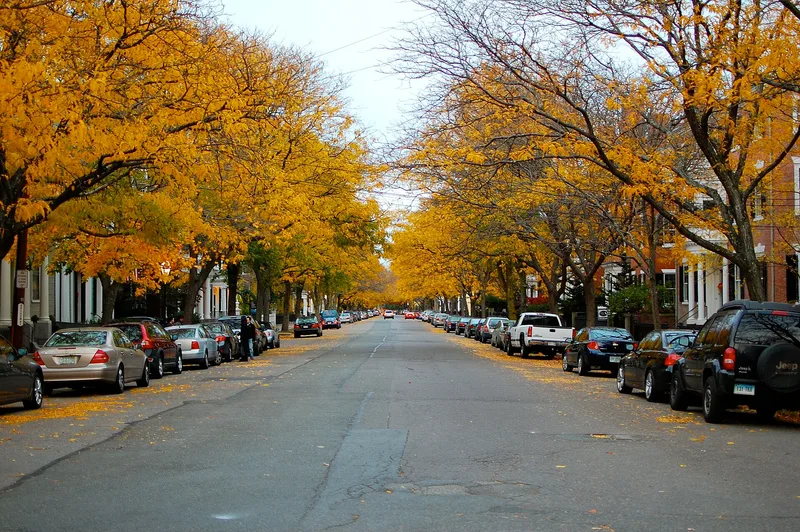
This addition to Salem's Chestnut Street Historic District takes in 23 houses on River, Lynn and Beckford Streets, built from the mid-18th to the early 19th century. The houses are two to two-and-a-half stories, with gambrel, ridge and saltbox roofs, and they are plainer versions of the Georgian, Federal and Greek Revival buildings found elsewhere in the district. Small lots, streets about 16 feet wide and tightly spaced buildings give the area a distinctive scale. The neighborhood housed Salem's artisans, craftsmen and small merchants rather than its wealthiest families. Benjamin Goodhue, a delegate to the 1789 Congress, built 9 Lynn Street around 1778, and housewright John Wright, who built the McIntire-designed Old Customs House, built 7 River Street. The area has changed little since the early 19th century, with no gaps or intrusions in the streetscape. Its largely undisturbed ground also offers potential for archeological study of late 18th and early 19th century life.
Significance in brief: The nomination argues the area is significant for its scale, architecture, archeological potential, associations and relationship to the existing district. It preserves the closely packed streetscape of Salem's artisans, craftsmen and small merchants, in contrast to the grander houses elsewhere in the district. Little development since the early 19th century suggests the archeological resources are relatively undisturbed.
Machine-generated summary. This summary was generated by a language model from the official nomination document and has not been reviewed line by line by an editor. It may contain errors. Check the source document before relying on any detail. Source: nomination document (PDF) · National Archives catalog entry. NRHP reference 78000468, listed October 4, 1978. Summary generated October 2026 (model claude-sonnet-5-5, prompt v1.0-2026-10-29, confidence medium).
Key facts
| Address | Roughly bounded by Bridge, Lynn, Beckford, and River Sts., Salem |
|---|---|
| County | Essex County |
| Listed | October 4, 1978 |
| Reference number | 78000468 |
| Resource type | District |
| Period of significance | 1700-1799, 1800-1899 |
| Architect / builder | John Wright, housewright (7 River Street); Benjamin Goodhue (9 Lynn Street, c. 1778) |
| Architectural style | Georgian, Federal and Greek Revival (modest examples) |
| Areas of significance | Community Planning and Development, Politics/Government, Architecture |
| Level of significance | National |
| Status (as stated in the nomination) | Described as an excellently preserved, cohesive streetscape with no gaps or intrusions; marked occupied and in private ownership. |
| Acreage | 2.5 |
| Coordinates | 42.52226, -70.90236 (NPS GIS) |
What listing means for this property
This is a historic district. Buildings within its boundary are either contributing (they add to the district's significance) or non-contributing. Owners of contributing income-producing buildings can claim the 20% federal rehabilitation tax credit; homeowners should look at state credits. National Register districts impose no design review by themselves; a local historic district ordinance, if one exists, does (the difference explained).
General information, not legal or tax advice. Rules change; confirm with your State Historic Preservation Office or a qualified adviser.
Sources and further reading
- National Park Service, National Register of Historic Places database (snapshot May 2026), reference 78000468.
- Nomination form (PDF, National Archives) — catalog entry
- Wikipedia article (used for cross-checking only; text not reproduced here)
- Wikidata Q5093998
- This listing as JSON
Last updated October 2026. Found an error? See the editorial policy for how to report it.