Loop Retail Historic District
Also known as: State Street; Wabash Avenue

Why it's listed
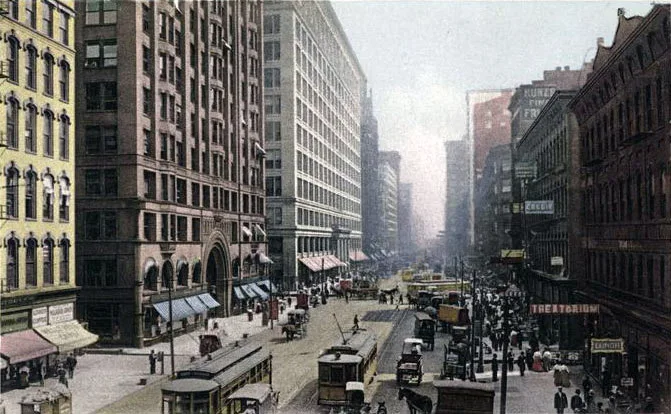
This stretch of downtown Chicago, centered on State Street and Wabash Avenue in the Loop, grew into the city's main shopping district. Its buildings, dating from 1872 to 1949, include department stores, tall shops, office towers, loft buildings, theaters and hotels, built tightly to the lot lines to form continuous streetwalls. Early loft buildings rose after the 1871 Chicago Fire, and the boom years from 1890 to World War I brought steel-frame department stores and narrow corner towers clad in terra cotta, many in the Chicago style. The 1897 Union Loop elevated structure forms a canopy over Wabash Avenue. Of 109 buildings and structures, 86 buildings and one structure contribute to the district's character, and thirteen are individually listed or are National Historic Landmarks. The district was recognized for its role in the history of downtown retail and wholesale luxury trade and for what is described as the largest and finest collection of commercial architecture in Chicago.
Significance in brief: The district was Chicago's main shopping district and the retail core of downtown. It is also described as the largest and finest collection of commercial buildings in the city, including five National Historic Landmarks and the city's largest grouping of Chicago School buildings. It is significant for commerce and for architecture.
Machine-generated summary. This summary was generated by a language model from the official nomination document and has not been reviewed line by line by an editor. It may contain errors. Check the source document before relying on any detail. Source: nomination document (PDF) · National Archives catalog entry. NRHP reference 98001351, listed November 27, 1998. Summary generated October 2026 (model claude-sonnet-5-5, prompt v1.0-2026-10-29, confidence medium).
Key facts
| Address | Roughly bounded by Lake St., Wabash Ave., Congress Parkway, and State St., Chicago |
|---|---|
| County | Cook County |
| Listed | November 27, 1998 |
| Reference number | 98001351 |
| Resource type | District |
| Period of significance | 1872-1949 |
| Architectural style | Chicago Commercial Style, Italianate, Renaissance, Queen Anne, Classical Revival, Tudor Revival, Late Gothic Revival, French Renaissance, Art Deco, Moderne, International Style |
| Criteria |
|
| Areas of significance | Architecture, Commerce |
| Level of significance | Local |
| Status (as stated in the nomination) | Most buildings retain historic form with some alterations; 86 buildings and one structure are contributing, 22 buildings are noncontributing, and one individual building (316 South Wabash) is noted as vacant. |
| Acreage | 26 |
| Coordinates | 41.88004, -87.62709 (NPS GIS) |
What listing means for this property
This is a historic district. Buildings within its boundary are either contributing (they add to the district's significance) or non-contributing. Owners of contributing income-producing buildings can claim the 20% federal rehabilitation tax credit; homeowners should look at state credits. National Register districts impose no design review by themselves; a local historic district ordinance, if one exists, does (the difference explained).
General information, not legal or tax advice. Rules change; confirm with your State Historic Preservation Office or a qualified adviser.
Sources and further reading
- National Park Service, National Register of Historic Places database (snapshot May 2026), reference 98001351.
- Nomination form (PDF, National Archives) — catalog entry
- Wikipedia article (used for cross-checking only; text not reproduced here)
- Wikidata Q6675813
- This listing as JSON
Last updated October 2026. Found an error? See the editorial policy for how to report it.