Hamilton Park
Also known as: Park #9

Why it's listed
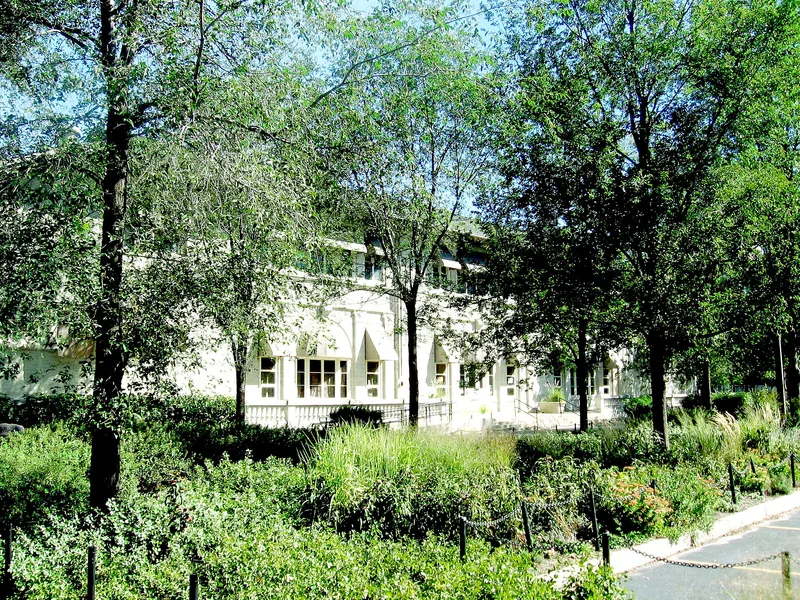
Hamilton Park is a 29.95-acre neighborhood park on Chicago's south side, bounded by 72nd and 74th Streets and flanked by railroad rights of way. The South Park Commission bought the land in 1904 and, working with the Olmsted Brothers and D. H. Burnham and Company, opened it by 1905 as one of a system of fourteen parks for neighborhoods without green space. The Olmsted landscape combines naturalistic planting with formal elements, centered on a large sunken ball field ringed by a tree-lined walk. At the north end stands the E-shaped fieldhouse, designed by Edward Bennett in poured concrete with exposed aggregate and classical detailing. A 1932 addition added an auditorium and a library branch. Other features include a concrete boiler house from 1931, viaducts dated 1916, planting-urn pedestals, and a former music court. The park remains in active use and keeps much of its original design, which is why it was recognized as a historic district with twenty-one contributing resources.
Significance in brief: The park is one of the neighborhood parks the South Park Commission developed with the Olmsted Brothers (landscape) and D. H. Burnham and Company (architecture). It follows the program of recreation facilities devised by J. Frank Foster for crowded neighborhoods that had no parks. It retains its original layout, its fieldhouse and a notable group of historic features.
Machine-generated summary. This summary was generated by a language model from the official nomination document and has not been reviewed line by line by an editor. It may contain errors. Check the source document before relying on any detail. Source: nomination document (PDF) · National Archives catalog entry. NRHP reference 95000487, listed April 20, 1995. Summary generated October 2026 (model claude-sonnet-5-5, prompt v1.0-2026-10-29, confidence medium).
Key facts
| Address | 513 W. 72nd St., Chicago |
|---|---|
| County | Cook County |
| Listed | April 20, 1995 |
| Reference number | 95000487 |
| Resource type | District |
| Architect / builder | Olmsted Brothers (landscape); Edward Bennett of D. H. Burnham and Company (fieldhouse); in-house architects of the South Park Commission/Chicago Park District (1932 addition, boiler house) |
| Architectural style | Late 19th and 20th Century Revivals/Beaux Arts; Modern Movement/Art Deco |
| Areas of significance | Landscape Architecture, Architecture, Entertainment/Recreation, Social History |
| Level of significance | National |
| Status (as stated in the nomination) | Continues to be actively used and retains a high level of integrity; 21 contributing and 2 noncontributing resources. |
| Acreage | 30 |
| Coordinates | 41.76154, -87.63723 (NPS GIS) |
What listing means for this property
This is a historic district. Buildings within its boundary are either contributing (they add to the district's significance) or non-contributing. Owners of contributing income-producing buildings can claim the 20% federal rehabilitation tax credit; homeowners should look at state credits. National Register districts impose no design review by themselves; a local historic district ordinance, if one exists, does (the difference explained).
General information, not legal or tax advice. Rules change; confirm with your State Historic Preservation Office or a qualified adviser.
Sources and further reading
- National Park Service, National Register of Historic Places database (snapshot May 2026), reference 95000487.
- Nomination form (PDF, National Archives) — catalog entry
- Wikipedia article (used for cross-checking only; text not reproduced here)
- Wikidata Q78505444
- This listing as JSON
Last updated October 2026. Found an error? See the editorial policy for how to report it.