Adler Planetarium
Also known as: Adler Planetarium and Astronomical Museum

Why it's listed
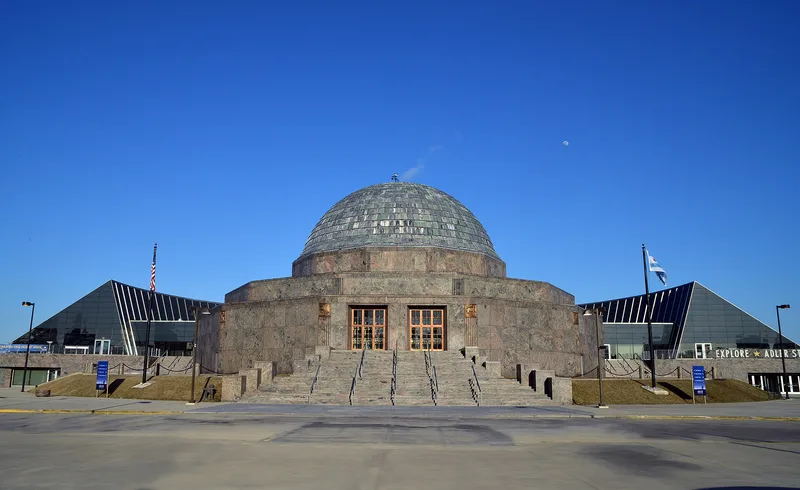
Perched on the northern tip of Northerly Island, a landfill peninsula in Lake Michigan, this planetarium and astronomical museum opened in May 1930 as the first of its kind in the Western Hemisphere. Architect Ernest Grunsfeld, Jr. designed a granite-clad building of three nested 12-sided rings rising to a copper-covered dome; the twelve sides recall the months and zodiac signs. Bronze zodiac plaques by Alfonso Ianelli decorate the corners. Max Adler, a retired Sears, Roebuck executive, funded the building, the projector and a large collection of antique scientific instruments. The planetarium joins the Field Museum and Shedd Aquarium in a lakefront cultural group, and these buildings survive as key remnants of the 1933-34 Century of Progress Exposition. Grunsfeld received an American Institute of Architects gold medal in 1930. A 1973 underground addition more than doubled the floor space without altering the setting, and over 22 million people have visited.
Significance in brief: The building was the first planetarium in the Western Hemisphere, given to Chicago by Max Adler. Together with the Field Museum, Shedd Aquarium and Soldier Field, it forms a cultural complex tied to the 1933-34 Century of Progress Exposition. Grunsfeld's design won an American Institute of Architects gold medal in 1930, and Carl Condit praised it as a 'classic in the modern idiom'.
Machine-generated summary. This summary was generated by a language model from the official nomination document and has not been reviewed line by line by an editor. It may contain errors. Check the source document before relying on any detail. Source: nomination document (PDF) · National Archives catalog entry. NRHP reference 87000819, listed February 27, 1987. Summary generated October 2026 (model claude-sonnet-5-5, prompt v1.0-2026-10-29, confidence high).
Key facts
| Address | 1300 S. Lake Shore Dr., Chicago |
|---|---|
| County | Cook County |
| Listed | February 27, 1987 |
| Reference number | 87000819 |
| Resource type | Building |
| Period of significance | 1929-30 |
| Architect / builder | Ernest Grunsfeld, Jr. (Planetarium) |
| Areas of significance | Entertainment/Recreation |
| Level of significance | National |
| National Historic Landmark | Yes, designated February 27, 1987 |
| Status (as stated in the nomination) | Described as in excellent condition though altered; a 1973 underground addition and a 1977 observatory were added. The building remains in use as a museum and planetarium. |
| Acreage | 8 |
| Coordinates | 41.86619, -87.60673 (NPS GIS) |
What listing means for this property
National Register listing is honorary: it recognises significance and does not restrict what a private owner may do without federal money or permits. It unlocks the 20% federal rehabilitation tax credit for income-producing buildings, state credits in many states, and Section 106 review when federal agencies are involved. See what listing means in practice.
General information, not legal or tax advice. Rules change; confirm with your State Historic Preservation Office or a qualified adviser.
Sources and further reading
- National Park Service, National Register of Historic Places database (snapshot May 2026), reference 87000819.
- Nomination form (PDF, National Archives) — catalog entry
- Wikipedia article (used for cross-checking only; text not reproduced here)
- Wikidata Q358052
- This listing as JSON
Last updated October 2026. Found an error? See the editorial policy for how to report it.