Shedd, John G., Aquarium

Why it's listed
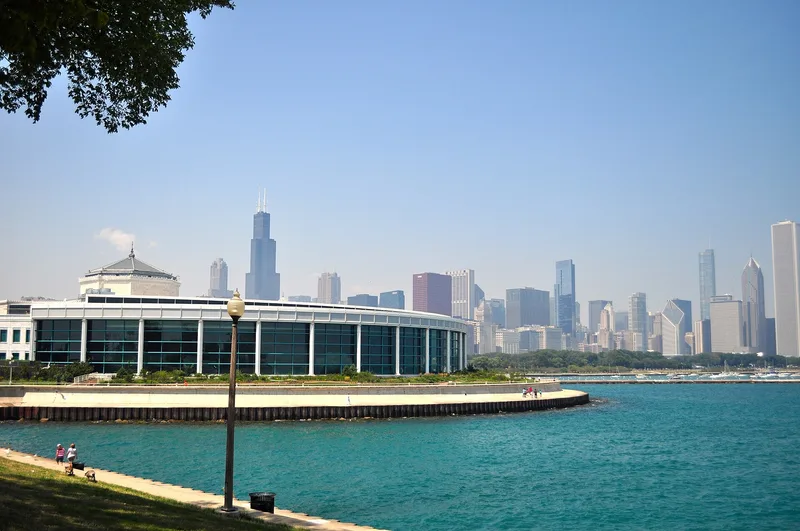
Built in 1929 and opened in June 1930 on the Chicago lakefront, this octagonal aquarium was the first inland aquarium in the United States to maintain permanent fresh-water and salt-water collections. Merchant John G. Shedd, a Marshall Field and Company executive, endowed it with a $2,000,000 agreement in 1925 and later added $1,000,000. The architects, Graham, Anderson, Probst and White, also designed the nearby Field Museum and made the aquarium harmonize with it. White Georgia marble covers the exterior, and a Doric temple portico marks the entrance. A skylit tower topped with a trident rises above the central rotunda. Inside, sea creature motifs appear in light fixtures, mosaics, brass railings and tiles. Galleries radiate from the rotunda, which now holds a coral reef tank installed in 1970. Together with the Adler Planetarium and the Field Museum, the aquarium forms a lakefront cultural group, and these buildings survive from the 1933-34 Century of Progress exposition.
Significance in brief: It was the first inland aquarium in the United States to keep a permanent collection of both fresh-water and salt-water fishes and other aquatic life. With the Adler Planetarium and the Field Museum it forms a cultural complex on the lakefront. Along with Soldier Field, these buildings are the main surviving on-site structures from the 1933-34 "A Century of Progress" exposition.
Machine-generated summary. This summary was generated by a language model from the official nomination document and has not been reviewed line by line by an editor. It may contain errors. Check the source document before relying on any detail. Source: nomination document (PDF) · National Archives catalog entry. NRHP reference 87000820, listed February 27, 1987. Summary generated October 2026 (model claude-sonnet-5-5, prompt v1.0-2026-10-29, confidence high).
Key facts
| Address | 1200 S. Lake Shore Dr., Chicago |
|---|---|
| County | Cook County |
| Listed | February 27, 1987 |
| Reference number | 87000820 |
| Resource type | Building |
| Period of significance | 1900- (specific date 1929) |
| Architect / builder | Graham, Anderson, Probst, and White |
| Architectural style | Classical (Classic Doric temple portico with simple Classic lines and marine-themed ornament) |
| Areas of significance | Entertainment/Recreation |
| Level of significance | National |
| National Historic Landmark | Yes, designated February 27, 1987 |
| Status (as stated in the nomination) | Described as in excellent condition, unaltered, on its original site, and occupied as a museum and recreation facility. |
| Acreage | 10 |
| Coordinates | 41.86768, -87.61397 (NPS GIS) |
What listing means for this property
National Register listing is honorary: it recognises significance and does not restrict what a private owner may do without federal money or permits. It unlocks the 20% federal rehabilitation tax credit for income-producing buildings, state credits in many states, and Section 106 review when federal agencies are involved. See what listing means in practice.
General information, not legal or tax advice. Rules change; confirm with your State Historic Preservation Office or a qualified adviser.
Sources and further reading
- National Park Service, National Register of Historic Places database (snapshot May 2026), reference 87000820.
- Nomination form (PDF, National Archives) — catalog entry
- Wikipedia article (used for cross-checking only; text not reproduced here)
- Wikidata Q2166515
- This listing as JSON
Last updated October 2026. Found an error? See the editorial policy for how to report it.