Dahlonega Commercial Historic District

Why it's listed
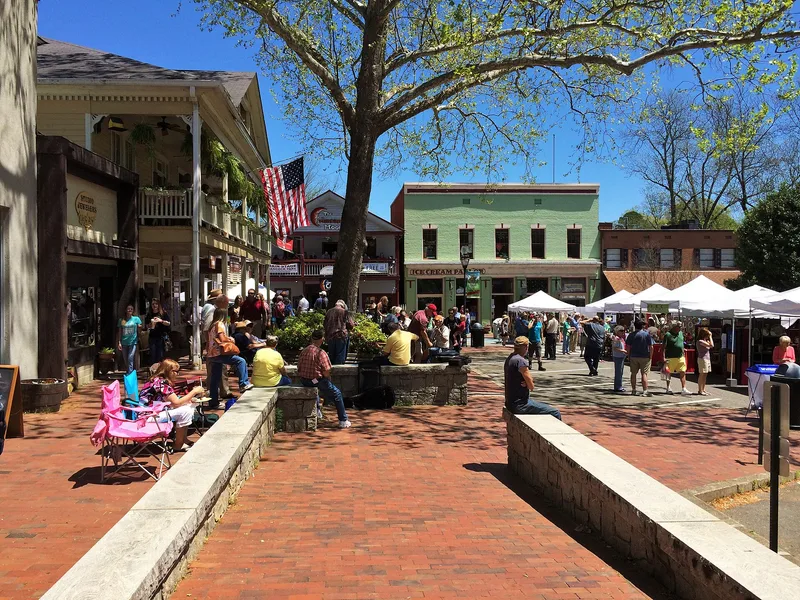
Dahlonega's downtown core is a compact district of roughly five acres arranged around a public square. The old Lumpkin County Courthouse, built in 1836 or 1838 in a vernacular Federal style and now the Gold Museum, sits at the center. Streets run in a gridiron pattern and meet the square at its corners. Around it stand one- and two-story brick and wood-frame buildings from the mid-nineteenth to early twentieth century, originally stores, banks, offices and a hotel, many with living space upstairs. Styles include Italianate, vernacular Second Empire, Victorian and vernacular commercial. The town was surveyed in 1833 as county seat of newly created Lumpkin County, five years after gold was discovered in the region. The district matters for that plan, for its architecture, including uncommon surviving wood-frame commercial buildings, and for its long role in local commerce and government. The courthouse served the county until 1965.
Significance in brief: The nomination argues the district is the historic commercial and civic center of Dahlonega and Lumpkin County. Its square-and-gridiron plan, laid out in 1833, reflects typical county seat planning. It also holds a variety of nineteenth and early twentieth century commercial buildings, including rare surviving wood-frame ones, and the old courthouse, one of Georgia's oldest.
Machine-generated summary. This summary was generated by a language model from the official nomination document and has not been reviewed line by line by an editor. It may contain errors. Check the source document before relying on any detail. Source: nomination document (PDF) · National Archives catalog entry. NRHP reference 83000235, listed April 7, 1983. Summary generated October 2026 (model claude-sonnet-5-5, prompt v1.0-2026-10-29, confidence medium).
Key facts
| Address | Chestates, Park, and Main Sts., Dahlonega |
|---|---|
| County | Lumpkin County |
| Listed | April 7, 1983 |
| Reference number | 83000235 |
| Resource type | District |
| Period of significance | mid 1800s through early 1900s |
| Architect / builder | Multiple |
| Architectural style | Federal, Italianate, vernacular Second Empire, Victorian Eclectic (Victorian Gothic in the significance section), and vernacular commercial |
| Criteria |
|
| Areas of significance | Community Planning and Development, Commerce, Exploration/Settlement, Politics/Government, Architecture |
| Level of significance | State |
| Status (as stated in the nomination) | Most buildings are occupied. Some storefronts have been remodeled and several non-historic commercial buildings sit in and around the district. The old courthouse is now the Gold Museum. |
| Acreage | 5 |
| Coordinates | 34.53214, -83.98467 (NPS GIS) |
What listing means for this property
This is a historic district. Buildings within its boundary are either contributing (they add to the district's significance) or non-contributing. Owners of contributing income-producing buildings can claim the 20% federal rehabilitation tax credit; homeowners should look at state credits. National Register districts impose no design review by themselves; a local historic district ordinance, if one exists, does (the difference explained).
General information, not legal or tax advice. Rules change; confirm with your State Historic Preservation Office or a qualified adviser.
Sources and further reading
- National Park Service, National Register of Historic Places database (snapshot May 2026), reference 83000235.
- Nomination form (PDF, National Archives) — catalog entry
- Wikidata Q141774278
- This listing as JSON
Last updated October 2026. Found an error? See the editorial policy for how to report it.